Thursday, March 31, 2022

Rising parental expectations linked to perfectionism in college students


Rising parental expectations and criticism are linked to an increase in perfectionism among college students, which can have damaging mental health consequences, according to new research published by the American Psychological Association.

Researchers analyzed data from more than 20,000 American, Canadian and British college students. They found that young people’s perceptions of their parents’ expectations and criticism have increased over the past 32 years and are linked to an increase in their perfectionism.

“Perfectionism contributes to many psychological conditions, including depression, anxiety, self-harm and eating disorders,” said lead researcher Thomas Curran, PhD, an assistant professor of psychological and behavioral science at the London School of Economics and Political Science.

Study co-author Andrew P. Hill, PhD, a professor of sport and exercise psychology at York St John University, added that “the pressure to conform to perfect ideals has never been greater and could be the basis for an impending public health issue.”

Perfectionism often becomes a lifelong trait and prior research has shown that perfectionists become more neurotic and less conscientious as they get older. Perfectionism also can perpetuate through generations, with perfectionist parents raising perfectionist children.

Curran and Hill previously found that three types of perfectionism were increasing among young people in the U.S., Canada and the United Kingdom. They suspected that one cause might be that parents are becoming more anxious and controlling, so they analyzed the findings of other published studies in two meta-analyses for this latest piece of research, which published online in the journal Psychological Bulletin

The first meta-analysis included 21 studies with data from more than 7,000 college students. Parental expectations and criticism had moderate associations with self-oriented and other-oriented perfectionism and a large association with socially prescribed perfectionism.

Self-oriented perfectionism involves perfectionist standards about the self. Other-oriented perfectionism is perfectionism turned outward, where someone expects others to be perfectionist. Socially prescribed perfectionism is the perception that other people and society require perfection. The three types of perfectionism overlap and can exacerbate the effects of each other in negative ways.

Parental expectations had a larger impact than parental criticism on self-oriented and other-oriented perfectionism, so parental expectations may be more damaging than parental criticism. 

“Parental expectations have a high cost when they’re perceived as excessive,” Curran said. “Young people internalize those expectations and depend on them for their self-esteem. And when they fail to meet them, as they invariably will, they’ll be critical of themselves for not matching up. To compensate, they strive to be perfect.”

Self-oriented perfectionism was higher for American college students than Canadian or British students, possibly because of more intense academic competition in the U.S.

“These trends may help explain increasing mental health issues in young people and suggest this problem will only worsen in the future,” Hill said. “It’s normal for parents to be anxious about their children, but increasingly this anxiety is being interpreted as pressure to be perfect.”

The second meta-analysis included 84 studies conducted between 1989 and 2021 with a total of 23,975 college students. Parental expectations, criticism and their combined parental pressure increased during those 32 years, with parental expectations increasing at the fastest rate by far. 

“The rate of increase in young people’s perceptions of their parents’ expectations is remarkable,” up an average 40% compared with 1989, Curran said.

The studies were conducted in the U.S., Canada and the United Kingdom, so the findings can’t be generalized to other cultures. The research is correlational, so it can’t prove that rising parental expectations or criticism caused an increase in perfectionism among college students, only that there is a link between them. However, the research suggests troublesome changes over time, according to the researchers.

So what are parents supposed to do? “Parents are not to blame because they’re reacting anxiously to a hyper-competitive world with ferocious academic pressures, runaway inequality and technological innovations like social media that propagate unrealistic ideals of how we should appear and perform,” Curran said.

“Parents are placing excessive expectations on their children because they think, correctly, that society demands it or their children will fall down the social ladder,” Curran added. “It’s ultimately not about parents recalibrating their expectations. It’s about society – our economy, education system and supposed meritocracy – recognizing that the pressures we’re putting on young people and their families are unnecessarily overwhelming.” 

Parents can help their children navigate societal pressures in a healthy way by teaching them that failure, or imperfection, is a normal and natural part of life, Curran said. “Focusing on learning and development, not test scores or social media, helps children develop healthy self-esteem, which doesn’t depend on others’ validation or external metrics,” he said.

Article: “Young People’s Perceptions of Their Parents’ Expectations and Criticism Are Increasing Over Time: Implications for Perfectionism,” by Thomas Curran, PhD, London School of Economics and Political Science, and Andrew P. Hill, PhD, York St John University, Psychological Bulletin, published online March 31, 2022.

Enrichment program in preschool = reduced levels of psychopathology symptoms moving from middle to secondary school


Objective:

Living in poverty increases exposure to adversities that undermine healthy development, impeding growth in the social-emotional and language skills that support adaptive coping and promote mental health. Evidence-based programs have the potential to improve current preschool practice and strengthen these early skills, potentially reducing risk for later psychopathology. The authors of this study tested the hypothesis that an enrichment program in preschool would be associated with reduced levels of psychopathology symptoms at the transition from middle to secondary school.

Methods:

The Head Start REDI (Research-Based, Developmentally Informed) intervention was used to enrich preschool classrooms serving children from low-income families with an evidence-based social-emotional learning (SEL) program and a coordinated interactive reading program. Centers were randomly assigned to the intervention or usual practice, and 356 4-year-olds (58% White, 25% Black, 17% Latino; 54% female) were followed into early adolescence. Hierarchical linear models were used to evaluate intervention effects on teacher-rated psychopathology symptoms using the Strengths and Difficulties Questionnaire in grade 7 (ages 12–13) and grade 9 (ages 14–15), 8–10 years after the end of the intervention.

Results:

Statistically significant intervention-related reductions were observed in conduct problems and emotional symptoms in the intervention group. In addition, the proportion of youths with clinically significant levels of conduct problems, emotional symptoms, and peer problems was reduced in the intervention group, with rates one-third of those in the control group.

Conclusions:

The study findings indicate that enriching preschool programs serving at-risk children with a relatively inexpensive evidence-based SEL program with interactive reading substantially improved the later benefits for adolescent emotional and behavioral health. This kind of SEL enrichment represents an approach that can leverage public investments in preschool programs to enhance public health.

Pandemic School Closures and Parents' Labor Supply


Hours worked declined for parents without college degrees but not for those with them, and childcare duties fell more heavily on mothers.

Two new studies show that school closures caused by the COVID-19 pandemic significantly reduced parents' labor market activity. They reach different conclusions about which demographic groups were most affected, one concluding that it was parents without college degrees, the other pointing to mothers with school-aged children. These disparities may be the result of the studies' analysis of somewhat different time periods and geographic areas.

In The Impact of School and Childcare Closures on Labor Market Outcomes during the COVID-19 Pandemic (NBER Working Paper 29641), Kairon Shayne D. Garcia and Benjamin W. Cowan report that parents, especially those without college degrees, responded to school closures by reducing their hours or shifting from full- to part-time work. They concentrate on the period from August 2020 to April 2021 because it covers the height of the pandemic and the first full academic term for which many schools switched to remote learning. Their study draws on cellphone data of foot traffic to pinpoint school closures, and on the Basic Monthly Current Population Survey for labor-supply information.

School closures were associated with a 3.8 percentage point decline in full-time work by mothers and a 2.5 percentage point decline by fathers, with the reductions primarily resulting from transitions to part-time work. Mothers on average worked 1.3 fewer hours a week and fathers 1.5 fewer hours. Parents without a college degree worked about two hours less per week, while those with college degrees showed negligible declines. Some studies of the early months of the pandemic — prior to the period considered in this study — found larger reductions in labor supply for mothers than for fathers, possibly because as the pandemic evolved, fathers pitched in more. Among unmarried parents, women were more likely than men to shift to part-time work; reductions in hours worked were comparable across genders. School closings were not associated with changes in labor supply among those who were not parents. The researchers explain the disparities across education groups by suggesting that more-educated workers were more likely to shift to working from home and to have access to alternative childcare arrangements or private schooling.

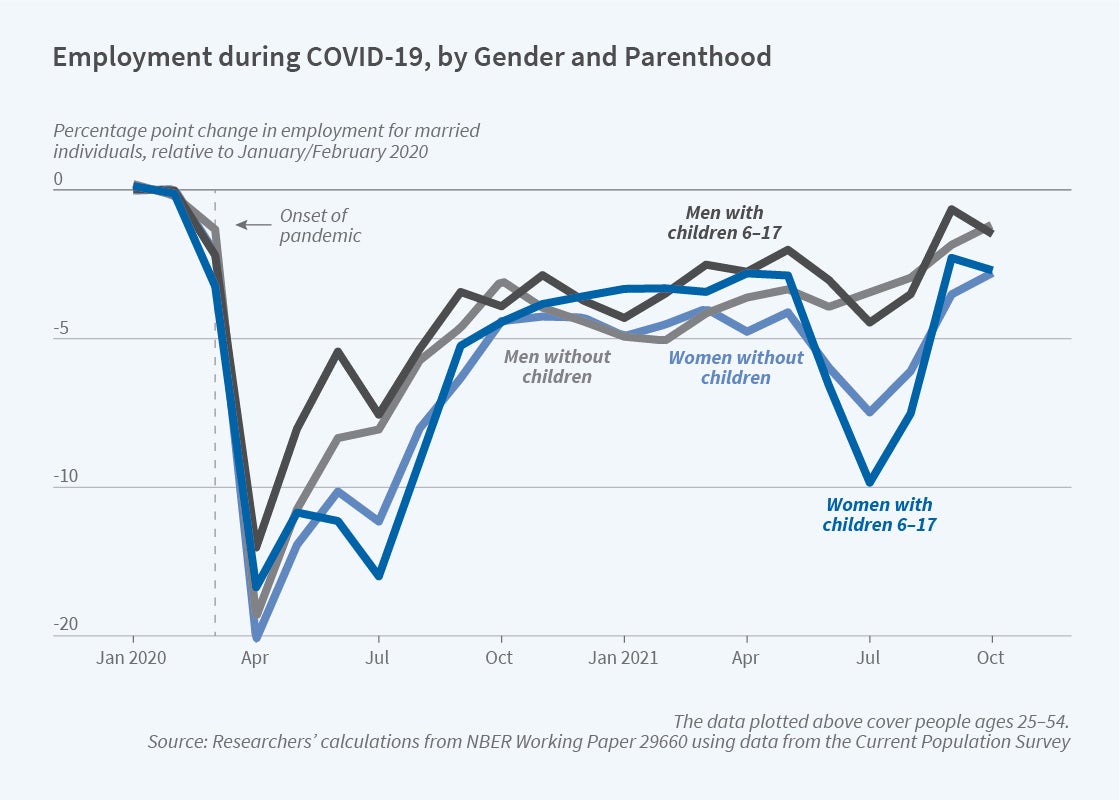
While Garcia and Cowan study changes in labor supply when schools close, Benjamin HansenJoseph J. Sabia, and Jessamyn Schaller also consider changes when they reopen. In Schools, Job Flexibility, and Married Women's Labor Supply: Evidence from the COVID-19 Pandemic (NBER Working Paper 29660), which also analyzes data from the Current Population Survey, they cover a broader time frame, September 2019 to October 2021. Their study spans all three academic years that were affected by the pandemic. It also includes a somewhat larger geographic area, with more rural locations, than the other study. The results suggest that in-person K-12 schooling was associated with employment gains for married women with school-aged children, but not for any other group, including single mothers and married custodial fathers.

After schools reopened, married women with school-aged children reported a 3.3 percentage point increase in employment and a 3.3 percentage point decline in remote work. The figures exclude women who were employed in the K-12 educational sector.

Mothers with and without college degrees showed comparable employment gains after schools reopened. Educational attainment, however, was a significant factor in work patterns. Mothers who completed college reduced remote work by 4.4 percentage points, versus a statistically insignificant 1.4 percentage point decline for those with less education.

The age of children made a difference. Mothers of children aged 12 to 17 saw a 3.9 percentage point increase in employment, compared with 2.5 percentage points for those with children aged 6 to 11. The decline in remote work was almost entirely among the mothers of the younger children. The researchers suggest that mothers with younger children may seek out jobs with greater flexibility, and that those with older children may have decided to leave the labor force when schools went remote in order to make sure that students kept up their grades.

— Steve Maas


Explaining the Decline of the US' Net Foreign Asset Position

Since the Great Recession, Americans have earned only moderate returns on their foreign investments while foreigners have reaped a bonanza on the boom in US stocks.

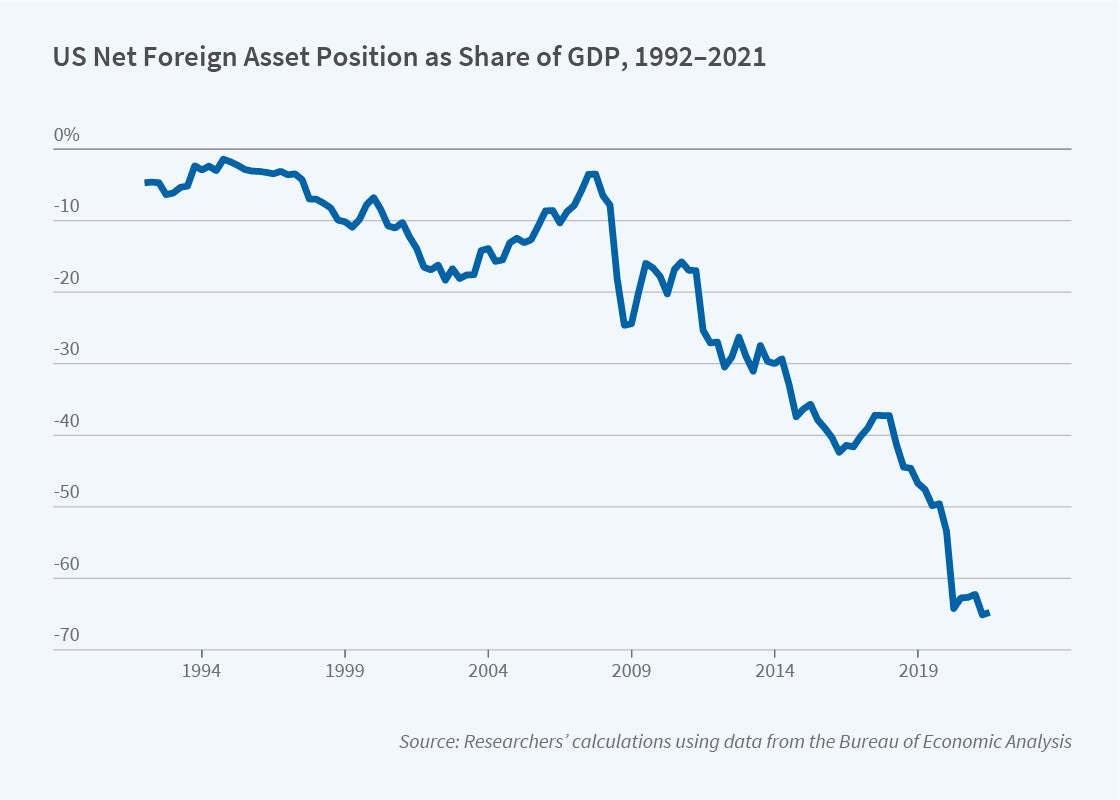
For decades, the United States appeared to enjoy a special privilege: although it imported more goods and services than it exported, its net foreign asset (NFA) position remained only slightly negative. Since the Great Recession, that privilege has disappeared and the NFA position — the difference between the foreign assets held by Americans and the US assets owned by foreigners — has declined sharply, even when measured as a percentage of gross domestic product (GDP).

In The End of Privilege: A Reexamination of the Net Foreign Asset Position of the United States (NBER Working Paper 29771), Andrew AtkesonJonathan Heathcote, and Fabrizio Perri analyze why the NFA has deteriorated so much. They find that most of the change can be explained by a boom in US equity values that was not matched by foreign stock prices. Their paper upends the conventional explanation for America's so-called special privilege, which for a time allowed the United States to fund its large trade deficit with its earnings on foreign assets.

In the early years of this millennium, the most common explanation for the US' small NFA position was that Americans owned high-return foreign equities while foreigners held low-return US assets such as Treasury bonds. Data available at the time supported that view. By analyzing newer federal data, however, more finely tuned to capturing economic and financial flows and balance sheet positions, the researchers uncover a different explanation. They find that the relative performance of foreign and US holdings within asset classes, rather than differences in the type of assets held, accounts for most of the changes in the US NFA position between 2010 and 2021.

The researchers divide the dynamics of the US NFA position into three phases. In the first, from 1992 to 2002, the US NFA position deteriorated from minus 5 to minus 18 percent of GDP, paralleling rising deficits in the current account. During the second phase, from 2002 to 2010, the NFA position was roughly stable while the current account continued its negative trend. This was the era of America's special privilege, as previous researchers dubbed it, because it appeared that the US could finance its trade deficits with the high returns earned on foreign assets. That privilege came to an end in the third phase, 2010–21, when the NFA position fell by more than 40 percent even though the current account as a percentage of GDP was roughly stable. By 2021, the decline in the US NFA position had not only negated the phase of special privilege, but had fallen to a lower level than would be indicated by the cumulated current account deficits over the full period from 1992&nda sh;2021.

The reason for the plunge during the third phase was a boom in US stock prices that was not matched elsewhere. While Americans were earning moderate returns on their foreign stocks and other financial investments, foreigners were earning very high returns on their US holdings.

The researchers consider two possible explanations for the stronger returns on US stocks than their global counterparts during the last decade. One is that US firms made substantial investments in productive capital that are not measured in the national accounts, while the other is that they experienced a rise in market power and a corresponding increase in monopoly profits. If the first explanation was correct, the US would have experienced a period of low or negative measured output and a huge trade and current account deficit, far beyond the deficit actually reported. The researchers conclude that since this was not observed, unmeasured investments may have contributed to the decline of the NFA position, but they are unlikely to be a dominant factor. A rise in monopoly profits and a larger share of value added accruing to the owners of firms, however, appears much more consistent with the NFA movement and other macroeconomic data. Since foreign investors own roughly 30 percent of the US corporate sector, their share of the increased profitability of this sector corresponds to an annual flow of about 1.3 percent of US GDP.

— Laurent Belsie


Enclosure of Rural England Boosted Productivity and Inequality

Parliamentary enclosures increased agricultural yields as well as inequality in the distribution of landholdings in enclosing parishes.

Enclosure involved privatizing rural land in England that had been in common ownership and consolidating scattered plots that had been farmed by individual households. The process began in the Middle Ages, and originally took place only when there was unanimous local agreement. At the beginning of the 18th century, large parts of the country had not been enclosed.

Around 1700, Parliament allowed owners of three-quarters of the land in an area, by value, to petition for an act of enclosure of all common property. This institutionalized a process for proceeding with enclosure over the opposition of some affected residents. By about 1900, virtually all of England was under private, consolidated ownership.

In The Economic Effects of the English Parliamentary Enclosures (NBER Working Paper 29772), Leander HeldringJames A. Robinson, and Sebastian Vollmer study all English Parliamentary enclosure acts between 1750 and 1830 and describe their impact. The researchers assemble data on agrarian outcomes in over 15,000 parishes, and they compare parishes that were enclosed in the Parliamentary period, 1750–1830, to those that were not enclosed by this method at the end of the period. Because the decision to file an enclosure petition likely correlated with parish attributes, the researchers develop an estimation strategy that draws on information on the success or failure of enclosure petitions for nearby parishes.

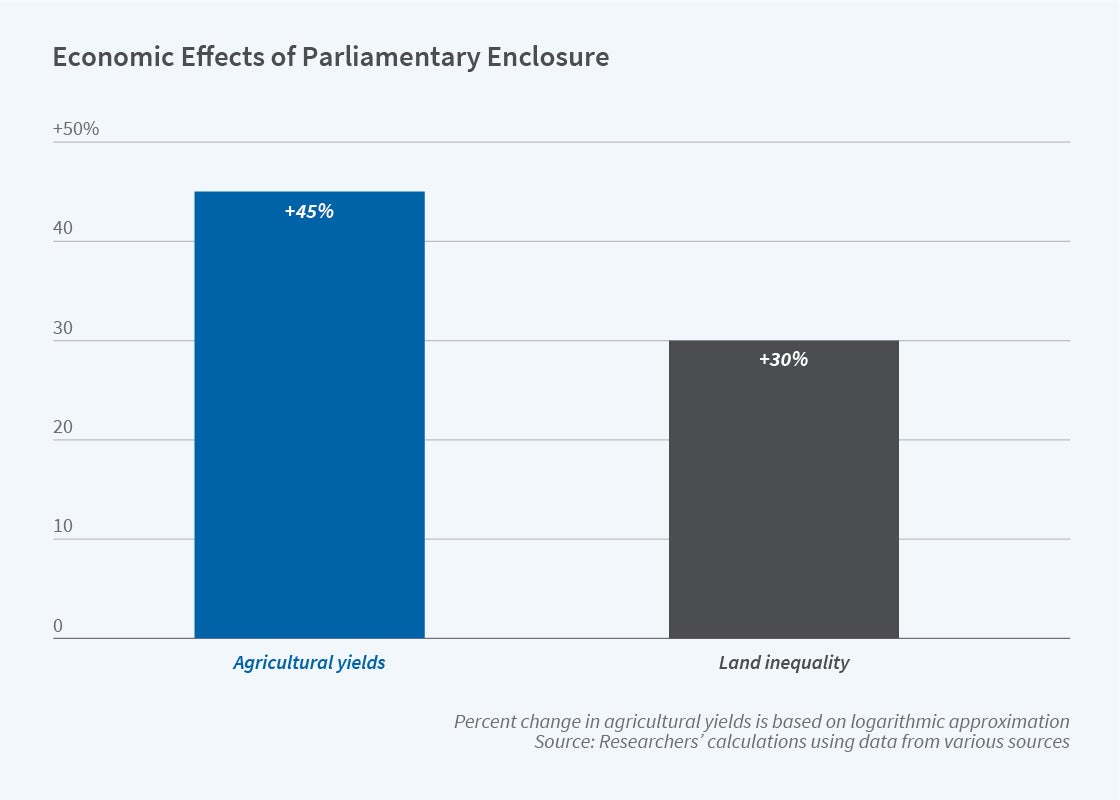
The analysis finds that by 1830, enclosures were associated, on average, with a 45 percent increase in agricultural yields. Inequality in land ownership, measured by the value of land held by different owners, also increased following enclosure. The researchers also estimate that the Gini coefficient, a common measure of income or wealth inequality, rose by 30 percent in parishes that enclosed relative to those that did not. These results are in line with theoretical arguments pointing to potential inefficiencies in shared governance and ownership of land. Even in communities as small, cohesive, and stable as a parish, informal governance mechanisms coordinating behavior and investment appear to have been less efficient than those of private ownership.

Contemporary advocates of Parliamentary enclosure suggested that it promoted investment, innovation, and experimentation in new techniques. The researchers explore the claim regarding innovation by examining the number of agricultural patents filed in a parish, which increased modestly following enclosure. The quality of local infrastructure, measured by the probability that surveyors rated a road in the parish to be of poor quality, also improved. The share of acreage in a parish that was either sown with turnips or subject to appropriate fallowing practices — ways to replenish depleted soils and improve output — also rose following enclosure. Prior to enclosure, the practices may not have been adopted because their implementation required coordination among villagers with disparate interests in commonly governed fields. Parliamentary enclosure gave everyone the freedom to implement best practices without the need for coordination.

— Lauri Scherer


Tuesday, March 29, 2022

Naptime may bolster early literacy skills among preschoolers


The ability to map letters to sounds is considered an important indicator of early literacy skills. Previous research shows that letter sound mappings in kindergarten is strongly associated with later reading success and some children later diagnosed as dyslexic may show poor letter-sound knowledge in the preschool years. However, there is little known research about the relationship between sleep, memory development, and literacy skills.

A new study published in Child Development provides initial evidence that daytime naps could be beneficial for preschool children’s learning of letter-sound skills. The research, conducted by scholars at Macquarie University in Australia, the University of Oxford, the University of York and the University of Sheffield investigated whether a daytime nap supports preschool children’s ability to learn letter sounds and to transfer this newly learned knowledge to the recognition of printed words. This study provides initial evidence that naps could be beneficial for preschool children’s learning of letter-sound mappings.

“Having a nap after learning might facilitate the capacity to utilize newly learned information in a new task,” said Hua-Chen Wang, Lecturer in the School of Education at Macquarie University. “We found a positive nap effect on children’s learning of letter-sound mappings, and in particular, using that knowledge to read unfamiliar words.”

Thirty-two three-to-five-year-old children from two daycare centers in Sydney, Australia who napped regularly participated in the study. The daycare centers did not provide formal teaching of letter names or sounds. 

Each child participated in seven sessions over two to four weeks which included the following:

  • Pre-test: To establish baseline levels of letter-sound knowledge.
  • Letter-sound mapping training: Held a week apart under both “nap” and “no-nap conditions.”  
  • Post-tests: To assess learning once after a nap and once after a period of wakefulness. To examine whether any effect of nap on learning was maintained, knowledge was also reassessed one day later. Each session assessed letter-sound mappings and using explicit learning (e.g., “Which sound does the letter C make?”) and knowledge generalization tasks (e.g., “Here’s Tav and Cav, which one is /kav/?”).

The authors predicted that if a nap benefits letter-sounds skills, then children who napped would perform better on both the explicit learning tasks (e.g., children were asked to produce or recognize the letter sounds they learned earlier) and knowledge transfer tasks (e.g., children were asked to identify unfamiliar words containing the letter sounds they learned earlier). The findings showed that napping did appear to positively affect performance on the knowledge transfer test. This nap benefit was maintained the following day. 

The authors acknowledge that because the study was conducted at daycare centers instead of in a laboratory (to make the children more comfortable), they were unable to measure physiological features of sleep such as rapid eye movement (REM) and how they are related to the sleep benefits. This would be an important direction for future research. The authors also note that since the nap effect was only found in generalizing letter-sound knowledge to recognizing printed words, but not on the explicit learning measures, future research on this topic with a larger sample size is recommended.  

“The research provides initial evidence that naps facilitate the acquisition and application of letter-sound mappings, abilities that are crucial to early reading development,” said Anne Castles, Professor of Psychological Studies at Macquarie University.  “These findings may have implications for creating the optimal conditions for the acquisition of this fundamental literacy skill in preschool children.”


School Experiences with COVID-19: February 2022


NCES releases the latest round of findings from the School Pulse Panel (SPP). These SPP data examine learning modes, quarantine prevalence, and COVID-19 mitigation strategies within schools. Findings include:

  • Ninety-nine percent of public schools offered in-person learning.
  • Ninety-five percent of public schools returned from winter break with no delays to learning.
  • Seventy-two percent of public schools quarantined students in February.
  • Twenty-six percent of public schools utilized the Test-to-Stay program.
  • Fourteen percentage point increase in on-site COVID-19 testing at public schools since September 2021.

The data released today can be found at the IES dashboard at https://ies.ed.gov/schoolsurvey/.

Monday, March 28, 2022

Study: To help Black students feel safer, schools must embrace their cultural identity

  To create a safer learning environment for Black students, schools should turn to culturally relevant and Afrocentric policies and practices that better incorporate their identity in the school culture, according to a new University at Buffalo-led study.

The research, published earlier this year in School Psychology International, suggested that practices such as allowing Black students and their families to co-create school rules, removing zero-tolerance discipline policies, creating mentorship programs that pair Black students with Black adults and promoting the use of mindfulness among students could have a positive impact on the educational experiences of Black youth.

Black students are more likely than any other racial group to experience exclusionary discipline such as suspensions and expulsions. The discipline gap exists as early as preschool, as Black preschool children are nearly four times more likely to receive suspensions than white preschool children, according to the United States Department of Education. 

Black students also report feeling less safe at school than White and Asian students, even when controlling for neighborhood factors, says lead author Kamontá Heidelburg, PhD, assistant professor of counseling, school and educational psychology in the UB Graduate School of Education.

“Ensuring a school environment that is physically and psychologically safe for students is critical for them to learn and grow, particularly for minoritized students continuously oppressed by systemic barriers,” says Heidelburg. “Culturally incongruent curricula, discipline disparities and bias from school staff are all part of the schooling experience for Black students. School safety must be reexamined and reconceptualized to promote a safe, secure and welcoming environment for Black students.”

Heidelburg and his co-authors – Chavez Phelps, PhD, assistant professor at Georgia State University; and Tai A. Collins, PhD, associate professor at University of Cincinnati – suggest numerous interventions to help foster a safe learning environment for Black students.

Among their recommendations:

School staff should highlight the accomplishments of Black people throughout society to better teach Black students about their history and help promote pride in their racial identity, allow Black students and their families the opportunity to co-create school rules to better fit their norms and values, and provide anti-bias and racial literacy training to school staff so that they can understand the intricacies of the Black experience in the U.S. and better discuss race and racism with students.

Schools should also use discipline data to identify the teachers who are most likely to issue discipline and the students who are most often targeted. Additionally, schools should replace zero-tolerance discipline policies and the use of school security measures – which push Black students out of school into the criminal justice system – with compassionate conflict resolution interventions such as classroom agreements and amend-making meetings.

The researchers also recommend mindfulness as a powerful tool to help empower Black youth to manage stress and their emotions. They add that school-based mentorships with Black adults help protect Black students from institutional barriers by helping them foster positive relationships with adults who are not their caregivers, make better life choices, and build their self-esteem and pride in their identity.

“Every Black student deserves to feel that they are seen and valued, and that they are safe in a world that rarely allows them to have such experiences,” says Heidelburg. “Schools are faced with an ultimatum and must decide to either be a part of the solution and better support the experiences of Black students or to maintain the status quo and further oppress Black students.”

Evidence on the Effective Design of Free Tuition Programs


Proposed "free college" policies vary widely in design. The simplest approach sets tuition to zero for everyone. More targeted approaches limit free tuition to those who successfully demonstrate need through an application process. 

This study experimentally tests the effects of these two models on the schooling decisions of low-income students. An unconditional free tuition offer from a large public university substantially increases application and enrollment rates. A free tuition offer contingent on proof of need has a much smaller effect on application and none on enrollment. The results suggest students place a high value on financial certainty when making schooling decisions.

Saturday, March 26, 2022

What Kids Are Reading: 2022 Edition,

This report is the world's largest annual study of K–12 student reading habits.

This free report provides a wealth of helpful information, including:

  • The top print and digital titles at every grade level
  • Lists of new & noteworthy titles and popular Spanish books
  • Titles that support social-emotional learning
  • Author essays and insights
  • And much more

Thursday, March 24, 2022

Arts activities reduce antisocial behavior among teenagers


Teenagers who take part in arts and cultural activities, such as dance, drama, reading and going to concerts, are less likely to engage in antisocial behaviour up to two years later.


Teenagers who take part in arts and cultural activities, such as dance, drama, reading and going to concerts, are less likely to engage in antisocial and criminalised behaviour up to two years later, according to a new study by UCL (University College London) and University of Florida researchers.

For the peer-reviewed study, published in the Journal of Youth and Adolescence (JOYO), researchers looked at data from more than 25,000 teenagers in the United States who had filled out questionnaires over several years.

They measured the teenagers’ overall engagement with arts activities based on a wide range of factors, from involvement in school clubs, orchestras, choirs, and arts classes outside school, to whether they had visited museums or been to concerts, or read on their own.

They found that the more of these activities the teenagers were involved in, the less likely they were to report being engaged in antisocial behaviour – ranging from misbehaving at school, to getting into fights, to criminalised behaviour such as stealing and selling drugs – both at the time of the first survey and when they were asked again about antisocial behaviour one and two years later.

The team also found that teenagers and young people who were more engaged in the arts were likely to have better self-control scores and view antisocial behaviour negatively. These outcomes have previously been found to make young people less likely to engage in antisocial and criminalised behaviours.

The research was carried out as part of the EpiArts Lab, a National Endowment for the Arts Research Lab.

Senior author Dr Daisy Fancourt (UCL Institute of Epidemiology & Health Care) said: “Past research has shown that getting involved in the arts can have a big impact on teenagers’ mental health and wellbeing.

“Our study adds to evidence about the wide-ranging benefits that arts and culture can have for young people, demonstrating a positive link between the arts and a lower prevalence of antisocial behaviour.

“Notably these findings remained, even when taking into account factors such as children’s age, gender, ethnicity, socio-economic background, their parents’ educational background, where they lived, and their previous patterns of antisocial behaviours.”

Lead author Dr Jess Bone (UCL Institute of Epidemiology & Health Care) said: “Our definition of arts and cultural engagement was very broad. It included dancing and acting in school clubs, reading, going to cinemas, museums, concerts, and music classes, as well as other hobbies that teenagers took part in regularly.

“Finding ways to reduce antisocial behaviour among teenagers is important because these behaviours may become established and continue into adulthood, affecting someone’s whole life.

“Our findings demonstrate the importance of making arts and cultural activities available for all young people, particularly in the wake of the Covid-19 pandemic, which has limited access to and funding for these resources.”

Researchers looked at data from two US-based longitudinal studies, the National Longitudinal Study of Adolescent to Adult Health and the National Education Longitudinal Study of 1988, whose participants were nationally representative. The research team analysed questionnaires filled in by teenagers and their parents between 1988 and 2002. The average age of participants at the start of these studies was 14 to 15 years.

In one of the cohorts, about half of adolescents reported engaging in antisocial and criminalised behaviours in the last 12 months. The average number of times participants engaged in these behaviours over the year was 1.6.

Although the researchers found that arts engagement was linked to fewer positive perceptions of antisocial behaviour and better self-control scores, they could not conclude that these factors were causally responsible for the association between arts engagement and antisocial behaviour as the study was observational.

Nonetheless, in considering mechanisms through which the arts could reduce antisocial behaviour, the researchers cited previous studies showing improvements from arts engagement including increased empathy, more prosocial behaviour, reduced boredom and improved self-esteem, as well as better emotion regulation.

Wednesday, March 23, 2022

Empathy softens teachers' biases, reduces racial gap in student suspensions


Large-scale intervention is found to combat inequities in school discipline


Interventions that seek to evoke empathy in teachers can sideline biases and narrow the racial gap in suspensions of middle school students, suggests new research from the University of California, Berkeley.

In one of the most rigorous efforts to date to combat race-based inequity in school suspensions, UC Berkeley social psychologist Jason Okonofua and fellow researchers recruited 66 middle school teachers who teach math to more than 5,500 7th and 8th grade students in one of the nation’s largest school districts.

After the teachers completed two online empathy-evoking sessions over the course of a school year, their students — especially those belonging to racial minorities — were less likely to get suspended, and the racial gap in suspensions was reduced by 45%, according to findings to be published in the journal Science Advances.

Moreover, the positive effects of the intervention persisted through the following school year when students had new teachers who were not involved in the empathy intervention. That second school year also saw fewer suspensions of students of color, as well as other vulnerable groups such as students who qualify for special education services. 

"By virtue of having one class with a teacher who participated in the intervention, a student, especially a Black or Hispanic student, was less likely to get in trouble during any other teacher's class that entire school year and also the next school year," said Okonofua, an assistant professor of psychology at UC Berkeley and the study's lead author.

The large-scale empathy intervention sought to narrow the suspension gap between Black and Latinx/Hispanic middle school students and their white peers. Nationally, Black male middle and high school students are four times as likely to be suspended as white students.

The school district that partnered in the study is a diverse one and spans more than a dozen cities in the southeastern United States. It cannot be identified due to confidentiality protocols.

Okonofua credits a nonjudgmental approach for circumventing racial and other biases in school disciplinary outcomes.

“Our intervention materials don’t focus on bias, or racial disparities in outcomes. That approach can put teachers on the defensive and backfire,” he said. “Instead, we reminded teachers of why they entered the profession in the first place, which for almost everyone means helping children learn and grow, even when they struggle sometimes or act out.”

The success of Okonofua's approach could play a key role in advancing former President Barack Obama’s stalled federal Every Student Succeeds Act, which sought to curb disciplinary measures that pull students out of classrooms and to find innovative alternatives to suspensions and expulsions.

“At a time when anti-bias training is not producing the improvements in outcomes we need to see, our empathy intervention was able to sideline teachers’ biases to reduce a racial disparity in suspensions in schools and do it in a sustainable way,” said Okonofua, who studies the impact of stereotyping on school discipline and the relationship between education and justice systems.

Previously, Okonofua and fellow researchers conducted a smaller-scale empathy intervention in three school districts in California that yielded similar results.

Researchers focused on middle school because adolescence is a time in which young people are learning to navigate relationships with multiple teachers, and peer relationships are in flux.

“Around this age, children become increasingly aware of racial stereotypes and sensitive to disrespectful treatment,” Okonofua said. “Meanwhile, teachers can feel overwhelmed by the daily need to keep classroom learning and behavior on track. Conflicts and disciplinary problems can spike and predict whether children will drop out of school.”

How they conducted the study

Over the 2017-18 school year, during two online sessions that each lasted less than an hour, participating teachers read poignant testimonials from students from diverse backgrounds.

They also read testimonials from teachers who described how they made efforts to listen to and understand students when they misbehave, and sustain positive and trusting relationships with their students.

In addition to writing about their approaches to discipline, the teachers described their reasons for entering the profession, and what advice they would share with new teachers.

“At the beginning of the year, I let (students) know that every day is a new day. … I won't give up on them. In my eyes, it is imperative to say what you mean in the most ‘real’ way, and students will believe you. Be honest and consistent," one teacher wrote.

Another teacher’s approach was to “incorporate a slight sense of humor in my lessons … and make a story out of solving math problems. The students typically laugh and understand the material better when I include real-world examples.”

For Okonofua, this open-minded approach to sidelining biases is promising for multiple professions where power differentials lead to conflict.

“We're looking at applying this type of approach in prisons, for police officers on the beat, and also in health care and the relationships between health care providers and their patients,” he said.

“Ultimately, we hope to help everyone double down on their professional goals, and not let stereotypes shape our decision-making or how we treat others,” he added.

In addition to Okonofua, researchers of the study are J. Parker Goyer and Gregory Walton at Stanford University, Constance Lindsay at the University of North Carolina at Chapel Hill.

Tuesday, March 22, 2022

Standardizing Applicant High School and Neighborhood Information Helps to Diversify Selective Colleges

 Many selective colleges consider the backgrounds of applicants to improve equity in admissions. However, this information is usually not available for all applicants. 

This study examines whether the chances of admission and enrollment changed after 43 colleges gained access to a new tool that standardizes information on educational disadvantage for all applicants. 

Applicants from the most challenging school and neighborhood backgrounds experienced a 5-percentage point increase in the probability of admission in the year of adoption relative to similar applicants in the previous year. The tool did not alter the probability of enrollment as a function of applicant challenge level in the full sample, but positive changes are concentrated among applicants to institutions that used the tool to allocate financial aid.

Trends in International Mathematics and Science Study


NCES has added data from the 2019 administration of the Trends in International Mathematics and Science Study (TIMSS) to the International Data Explorer (IDE).

The IDE is an online, interactive tool that allows users to explore international study data and create customized tables, charts, maps, and analyses. TIMSS is an international comparative study that measures trends in fourth- and eighth-grade mathematics and science achievement every 4 years.

New data include TIMSS 2019 results for mathematics and science scales and subscales, as well as contextual data from the student, teacher, and school questionnaires. These new 2019 data are available for the United States and about 60 other participating countries and education systems across six continents.

The TIMSS IDE now includes data from all seven administrations of TIMSS (1995, 1999, 2003, 2007, 2011, 2015, and 2019).

Start exploring the TIMSS data in the IDE at: https://nces.ed.gov/surveys/international/ide/.

For more information about TIMSS, visit the website at: https://nces.ed.gov/timss/.

TIMSS is coordinated internationally by the International Association for the Evaluation of Educational Achievement (IEA) and managed in the United States by NCES at the Institute of Education Sciences, part of the U.S. Department of Education. The IDE is a product of NCES.

National poll: More than 1 in 4 parents say their adolescent has seen a mental health specialist


Just 4 in 10 parents say their child’s provider asks about mental health concerns at all check-ups and nearly half who seek mental health services for their adolescent describe difficulties getting care.


Recognizing mental health issues in adolescents 

IMAGE: ALMOST ALL PARENTS FELT SOMEWHAT OR VERY CONFIDENT THEY WOULD RECOGNIZE A POSSIBLE MENTAL HEALTH ISSUE IN THEIR ADOLESCENT. view more 

CREDIT: UNIVERSITY OF MICHIGAN HEALTH C.S. MOTT CHILDREN’S HOSPITAL NATIONAL POLL ON CHILDREN’S HEALTH

Amid growing concerns for children’s mental health during the pandemic era, more than a quarter of parents say their adolescent-aged child has seen a mental health specialist – with nearly 60 % of those reporting a visit within the past year – a new national poll suggests.

But screening and navigating the mental health care system remains difficult for many parents. While almost all parents say they’re confident they would recognize a possible mental health issue in their child, much fewer say their child is regularly screened for mental health by their provider or that it’s easy to get the care they need once they recognize a problem.

The findings come from a nationally representative report from the University of Michigan Health C.S. Mott Children’s Hospital National Poll on Children’s Health in collaboration with the Children’s Hospital Association. The report, which comes less than a year after children’s mental health was declared a national emergency in the U.S, is based on responses from 1,201 parents of children ages 11-18 surveyed in October 2021.

“Even before the pandemic, mental health disorders in adolescents, such as depression and anxiety, were prevalent,” said Mott Poll co-director and Mott pediatrician Gary L. Freed, M.D., M.P.H.

“The pandemic caused significant stress and social disruption for kids that likely exacerbated these problems, as we’re seeing a growing number of young people face mental health concerns. This places a heavier burden on parents, health providers and other trusted adults in their lives to be aware of potential warning signs.”

Screening for mental health issues

While a third of parents say their adolescent has completed a mental health screening questionnaire at their primary care office, only four in ten say their adolescent’s provider asks about mental health concerns at all well child visits. One in seven say their provider never asks about mental health concerns.

“Regular check-ups are the best time for providers to discuss potential mental health concerns,” Freed said. “If parents feel their adolescent’s provider is not being proactive in raising these issues, they should bring it up with them.”

It’s also important for adolescents themselves to feel comfortable seeking help, Freed notes.

Only a quarter of parents polled, however, thought their adolescent would definitely talk to them about a possible mental issue, and even fewer thought their adolescent would open up with their primary care provider.

There are some steps parents can take to help, Freed notes. He recommends having open conversations with kids that give them opportunities to discuss issues and emphasize that asking for help “isn’t a sign of weakness but of strength.” They can also prepare them for health visits by reinforcing the importance of sharing concerns with providers and also allow their child privacy during the visit.

“Being good listeners and initiating open, non-judgmental conversations about mental health can help reduce stigma and make kids feel more comfortable,” Freed said. “It may also be helpful for parents to share any of their own experiences with mental health challenges.”

“Before seeing a doctor, adolescents should understand that their doctor is there to help and that they should be as honest as possible about any physical or mental health problems.”

Identifying warning signs

Even before the added stress and disruption of the pandemic, one in five adolescents had a diagnosable mental health disorder, including depression and anxiety. Several reports indicate that these challenges may have worsened during the pandemic.

While it may be difficult for parents to tell the difference between their adolescent’s normal ups and downs and mental illness, parents polled seemed to know what to look for. Among signs that would prompt their concern were frequent comments about being worried or anxious, moodiness, decreased interaction with family, a drop in grades or changes in sleep or eating patterns.

If parents notice a possible mental health issue, most say their first response would be to talk with their adolescent or keep a closer eye on them. Fewer parents’ first response would be to make an appointment with a healthcare provider, check in with their adolescent’s teacher or get advice from family or friends.

The stigma of mental illness may make parents hesitant to seek help or delay seeking care for their adolescent as they may think the symptoms will go away on their own, Freed said. But it’s important to take the next step if needed.

“Signs of struggles with mental health can look different for every child, and some may be easier to recognize than others,” Freed said. “Parents should take seriously any major changes to their baseline behavior that could be a symptom of something more concerning.

“If adolescents seem overwhelmed by trying to manage challenges, parents should seek professional help.”

Barriers in receiving mental health care

More than half of parents say they decided on their own to have their adolescent see a mental health specialist while less than one in five got a referral from their adolescent’s primary care provider or school.   

But even after recognizing a problem, some parents also have trouble navigating the health system to find a mental healthcare evaluation or treatment options for their adolescent, the poll finds.

Nearly half of parents who tried to do so, describe difficulties getting their adolescent care with a mental health specialist, including long waits for appointments, finding a provider who took their insurance or saw children. Ten percent of parents also said they simply just didn’t know where to go.

Experts say parents should reach out to their adolescent’s primary care giver for help in finding a mental health provider and support from their communities. Some programs, such as the MC3 program at University of Michigan, helps connect primary care providers with psychiatrists and behavioral specialists for consultation and training to help address mental health needs in local clinics.

“Difficulties finding and getting mental health care for youth reflects strains in our current mental health system and highlights the need for more ways to support parents and their children,” added Amy Wimpey Knight, president of CHA.

“Parents whose children need mental health help should remember they aren’t alone. But they may need to be proactive and persistent in seeking support from a provider, their school, or family or friends in caring for mental health issues.”

Monday, March 21, 2022

Pretrial juvenile detention leads to a 31% decline in the likelihood of graduating high school

 Roughly one in four juveniles arrested in the U.S. spend time in a detention center prior to their court date. To study the consequences of this practice for youth, this paper links the universe of individual public school records in Michigan to juvenile and adult criminal justice records. 

Using a combination of exact matching and inverse probability weighting, the authors estimate that juvenile detention leads to a 31% decline in the likelihood of graduating high school and a 25% increase in the likelihood of being arrested as an adult. Falsification tests suggest the results are not driven by unobserved heterogeneity.

The Higher Education-Innovation Gap

This paper documents differences across higher-education courses in the coverage of frontier knowledge. Comparing the text of 1.7M syllabi and 20M academic articles, the authors construct the "education-innovation gap," a syllabus’s relative proximity to old and new knowledge. They show that courses differ greatly in the extent to which they cover frontier knowledge. 

More selective and better funded schools, and those enrolling socio-economically advantaged students, teach more frontier knowledge. Instructors play a big role in shaping course content; research-active instructors teach more frontier knowledge. Students from schools teaching more frontier knowledge are more likely to complete a PhD, produce more patents, and earn more after graduation.

Students exposed to additional funding during elementary school were substantially less likely to be arrested in adulthood

 This paper asks whether improving the quality of public schools can be an effective long-run crime-prevention strategy in the U.S. Specifically, the paper examines the effect of school quality improvements early in children's lives on the likelihood that they are arrested as adults.

 The first research design exploits variation in operating expenditures due to Michigan's 1994 school finance reform, Proposal A. The second design exploits variation in capital spending by leveraging close school district capital bond elections in a regression discontinuity framework. 

In both cases, students exposed to additional funding during elementary school were substantially less likely to be arrested in adulthood. The Marginal Value of Public Funds of improving school quality (via increases in funding) is greater than one, even when considering only the crime-reducing benefits.

Thursday, March 17, 2022

Teachers, other school personnel, experience violence, threats, harassment during pandemic


Almost half of teachers express desire to quit or transfer, survey says


While much of the focus on education during the pandemic has involved the effects on children in schools, it is also having a negative impact on teachers, administrators, social workers, psychologists and school staff. Approximately one-third of teachers report that they experienced at least one incident of verbal harassment or threat of violence from students during the pandemic, and almost 50% expressed a plan or desire to quit or transfer jobs, according to a survey conducted by a task force of the American Psychological Association.

“As teachers and schools learn to adjust to the realities of education during COVID, it is important to understand school safety concerns and how best to address them to create an effective and safe environment for students, teachers and school staff,” said Susan Dvorak McMahon, PhD, of DePaul University, chair of the APA Task Force on Violence Against Educators and School Personnel, which conducted the survey in collaboration with national education and related organizations. 

The task force surveyed 14,966 participants – 9,370 teachers, 860 administrators, 1,499 school psychologists and social workers, and 3,237 other pre-K through 12th grade school staff members (e.g., paraprofessionals, instructional aides, school resource officers, school counselors) – from all 50 U.S. states and Puerto Rico. As described in a technical report that elaborates on the survey, the largest portion of the participants came from the Southern U.S. (38.17%), while the Northeast accounted for the fewest participants (13.12%). More than 94% of participants were from public schools. The racial/ethnic distribution of the entire sample was similar to the racial/ethnic distribution of teachers in the United States. Data was collected from July 2020 to June 2021, while many schools were operating in online or hybrid modes due to the pandemic.

Participants were asked about their experience with threats of violence (including verbal harassment, threats or cyberbullying) from students, parents/guardians, colleagues and administrators, as well as physical violence from students. They were also asked about their desire or intention to quit, retire early or transfer to another position in the school or school district. The survey also included a series of open-ended, qualitative questions asking participants to share details of their experiences, expand on their concerns and offer recommendations for solutions.

One out of every three teachers (33%) reported at least one incident of verbal harassment or threatening behavior from a student, and 29% reported at least one incident from a parent of a student. The numbers were even higher for school administrators: Approximately 37% reported at least one incident of harassment or threat of violence from a student and 42% reported the same from a parent.

Approximately 14% of teachers reported incidents of physical violence from a student. And it wasn’t just teachers. At least 18% of school psychologists and social workers, 15% of school administrators and 22% of other school staff reported at least one violent incident by a student during the pandemic.

“I have been physically assaulted multiple times by students in the building and they know that not only is there no one to stop them, but there will be no consequences either,” said one teacher who responded to an open-ended question on school safety concerns. “I ended up in the hospital the last time it happened.”

The toll of all the harassment and violence against teachers and school staff is formidable, according to McMahon. The survey found nearly half (49%) of teachers expressed a desire or plan to quit or transfer to another school. More teachers reported a desire to quit (43%) than to transfer (26%). Although not as high as among teachers, a large percentage of school psychologists and school social workers (34%), school administrators (31%) and other school staff (29%) also reported a desire or plan to quit or transfer.

“Violence against educators is a public health problem, and we need comprehensive, research-based solutions,” said McMahon. “Current and future decisions to leave the field of education affect the quality of our schools and the next generations of learners, teachers and school leaders in the nation. Physical and verbal violence directed against school personnel may be exacerbating reports of high stress, transfers and leaving the profession.”

In response to the survey findings, the task force offered recommendations to address violence against school personnel, including:

  • Supporting the mental health of school personnel as well as students and promoting trauma-informed practices.
  • Enhancing school organizational functioning by including educators’ voices in decision-making.
  • Increasing school capacity by meeting the professional development needs of educators and school personnel and addressing the socio-emotional and mental health needs of students.
  • Providing research-based systemic training to prevent school violence and reducing the use of zero tolerance policies in response to troubling behavior, a practice that has not been found to reduce infractions.
  • Improving preparation programs for educators by providing more training to help better understand and address the social-emotional needs not only of students but of themselves and other educators.

The task force also identified a series of actions that could be taken by Congress, including enacting bills being considered and funding priorities that could help address the issues identified by the survey.

Wednesday, March 16, 2022

High school graduates’ academic performance and coursetaking patterns


A new NCES report, the 2019 NAEP High School Transcript Study (HSTS) Results, describes the coursetaking patterns and academic performance of graduates from a national sample of U.S. public and private schools who also took the 2019 NAEP twelfth-grade mathematics and science assessments.  This report uses data from the 1990, 2000, 2009, and 2019 NAEP HSTS for coursetaking results and from 2005, 2009, and 2019 for comparisons to NAEP, located at https://www.nationsreportcard.gov/ndecore/landing.
 
The study of high school graduates’ academic performance and coursetaking patterns is based on an analysis of their transcripts and NAEP twelfth-grade mathematics and science assessment results.  HSTS show trends from 1990, 2000, 2009, and 2019 in grade point averages, course credits earned, curriculum levels, and various coursetaking patterns.  The 2019 HSTS uses a new course classification system, the School Courses for the Exchange of Data (SCED), to provide a more detailed breakdown of cross-disciplinary coursetaking programs such as Career and Technical Education (CTE) and Science Technology Engineering and Mathematics (STEM) coursetaking.  
 
The study also compares graduates’ average NAEP scale scores from the twelfth-grade mathematics and science assessments to the academic achievement reported in their transcripts.  The linkage of the NAEP twelfth-grade mathematics and science assessments to HSTS provides the opportunity for school leaders, policy makers, and researchers to analyze student performance by a rich set of HSTS and NAEP contextual factors.

Overview
Coursetaking measures derived from high school graduates’ transcripts have increased in 2019 compared to 2009 and previous HSTS years. High school graduates are earning more credits, especially in academic subjects; grade point averages are climbing; and graduates are attaining higher curriculum levels (which are measures of the rigor of student coursework). Furthermore, high school graduates are taking more science, technology, engineering, and mathematics (STEM) courses. However, the performance of high school graduates on the NAEP Grade 12 mathematics and science assessments paints a different picture. The average NAEP mathematics assessment scores of high school graduates in 2019 has decreased compared to 2009, while their NAEP science assessment scores were similar compared to 2009. While the majority of high school graduates in 2019 attained a midlevel curriculum, the average NAEP mathematics and science assessment scores of those graduates who attained a midlevel curriculum were within the NAEP Basicachievement levels.
  • Core indicators of student coursetaking are increasing.
    • The number of Carnegie credits earned by high school graduates increased to 28.1 credits in 2019, compared to 27.2 credits in 2009. The largest component of this increase came from academic courses, of which graduates earned 20.8 credits in 2019 compared to 20.2 credits in 2009.
    • The overall grade point average (GPA) earned by high school graduates increased to 3.11 in 2019, compared to 3.00 in 2009.
    • The percentage of high school graduates who attained a standard curriculum or higher increased across the assessment years. The percentage of high school graduates who did not attain a standard curriculum decreased to 16 percent in 2019, compared to 23 percent in 2009.
  • More high school graduates are completing STEM courses in 2019 than in 2009.
    • The percentage of high school graduates earning credits in STEM courses increased within all three subject areas–STEM advanced mathematics, STEM advanced science and engineering, and STEM-related technical courses. Compared to 2009, the percentages of high school graduates earning STEM credits in 2019 increased from 3 percentage points (STEM-related technical) to 7 percentage points (STEM advanced mathematics).
    • Compared to 2009, the overall percentage of high school graduates taking career/technical education (CTE) courses remained at 85 percent. However, the percentage increased in some CTE subjects, such as engineering and technology and health care sciences.
  • Gains in high school graduates’ coursetaking are not reflected in their NAEP Grade 12 mathematics and science assessment scores.
    • When comparing 2019 to 2009, the average NAEP Grade 12 mathematics assessment score decreased at the higher curriculum levels. The average NAEP mathematics score earned by high school graduates attaining a rigorous curriculum in 2019 was 184, a four-point decrease compared to 2009. For graduates attaining a midlevel curriculum, the average NAEP mathematics score was 153 in 2019, a five-point decrease compared to 2009.
    • The average NAEP Grade 12 science assessment scores did not significantly change at any curriculum level in 2019 compared to 2009.