Friday, June 28, 2013
New NAEP Report Compares Today’s Student Performance With That of 40 Years Ago
Long-term trend assessment shows improvement
for black and Hispanic students since the 1970s
Today’s 9-and 13-year-old students scored higher in reading and mathematics than their counterparts did 40 years ago according to The Nation’s Report Card: Trends in Academic Progress 2012, a long-term trend assessment designed to track changes in the achievement of students ages 9, 13 and 17 since the 1970s. However, 17-year-olds did not show similar gains.
The National Assessment of Educational Progress (NAEP) long-term trend assessment is administered every four years and measures basic reading and mathematics skills to gauge how the performance of U.S. students has changed over time. Reading was first assessed in 1971, and mathematics in 1973. Results in 2012 from more than 50,000 public-and private-school students across the country are compared with assessments since the 1970s and offer an extended view of changes in achievement over the years.
Also known as The Nation’s Report Card, NAEP main assessments monitor student achievement at grades 4, 8 and 12 and are given to a nationally representative sample of students in reading, mathematics and many other subjects. The long-term trend differs from the main NAEP assessments in both its questions and its measurement of achievement, aiming to capture changes over time in student progress. The long-term assessment results are reported in average scores (0 to 500), at percentiles (10th and 25th, or lower performing; 50th, or middle; and 75th and 90th, or higher performing), and performance levels of 150, 200, 250, 300 and 350.
Most notable in the long-term trend report is the improvement in scores among today’s black and Hispanic students compared with black and Hispanic students who took the assessments years ago. In 2012, 9-year-old black students on average scored 36 points higher than their counterparts in the early 1970s in both reading and mathematics; 13-year-olds scored an average of 24 points higher in reading and 36 points higher in mathematics. Hispanic students at age 9 scored an average of 25 points higher in reading and 32 points higher in mathematics than their counterparts in the 1970s. At age 17, average scores for Hispanic students rose 21 points in reading and 17 points in mathematics. Score gaps between white students and other racial/ethnic groups persist, although those gaps are generally smaller than they were four decades ago.
In addition, the results show the gender gap is narrowing in each subject. At all ages, female students on average are scoring better in mathematics than they were 40 years ago. In reading, score gains from 1971 to 2012 for male students narrowed the gap at age 9. While female students continue to score higher than male students at that age, the increase in male students’ average scores narrowed the gender gap by about 8 points, from a 13-point gap in 1971 to a 5-point gap in 2012.
Some of the biggest changes in achievement gaps between 1971 and 2012 include a 27-point narrowing between the average scores of black and white 17-year-old students in reading. Also in reading, the difference in average scores of black and white 9-year-old students went from 44 points to 23 points. In reading at age 13, the gap between average scores for black and white students narrowed from 39 points to 23 points. In mathematics, at age 13, the gap between the average scores for black and white students narrowed from 46 points in 1973 to 28 points in 2012.
Additional report findings:
* Scores for lower performing students are higher for all 3 age groups compared with those 40 years ago: In reading, lower performing 17-year-olds at the 10th and 25th percentiles made gains in mathematics at age 13; long-term gains made by lower performing students were larger than the gains made by higher performing students.
* At all ages, students who read for fun outside of class daily, or once or twice a week, on average scored higher than those who reported reading for fun a few times a year or less.
* Comparing the time spent reading for fun in 2012 and in 1984, the percentage of 9-year-old students in 2012 who read for fun is unchanged, but there is a decrease in reading for pleasure among those ages 13 and 17.
* Since 1986, the percentage of 13-year-old students taking algebra has doubled, and the percentage of 17-year-olds taking pre-calculus or calculus has more than tripled since 1978.
* Compared with the 1970s, a higher percentage of students at each age are in a grade below the one considered typical for their age.
* Compared to the first assessment in 1971 for reading and in 1973 for mathematics, scores were higher in 2012 for 9- and 13-year-olds and not significantly different for 17-year-olds.
* In both reading and mathematics at all three ages, Black students made larger gains from the early 1970s than White students.
* Hispanic students made larger gains from the 1970s than White students in reading at all three ages and in mathematics at ages 13 and 17.
* Female students have consistently outscored male students in reading at all three ages, but the gender gap narrowed from 1971 to 2012 at age 9.
* At ages 9 and 13, the scores of male and female students were not significantly different in mathematics, but the gender gap in mathematics for 17-year-olds narrowed in comparison to 1973.
\

Thursday, June 27, 2013
Teachers Spend $1.6 Billion of Their Own Money on Educational Products for their Classrooms
The National School Supply and Equipment Association (NSSEA) has just released the 2013 NSSEA Retail Market Awareness Study estimating that public school teachers spent $3.2 billion in educational products in the 2012-2013 school year, $1.6 billion of it from their own pockets. This study reports on teachers' knowledge of parent-teacher stores, including their spending patterns, funding sources, shopping preferences, and factors that influence their purchasing decisions.
Other highlights:
- On average, teachers surveyed said they spent a total of $268 on school supplies in the 2012-2013 school year, $491 on instructional materials and an additional $186 on other classroom supplies for an average total of $945 on materials for their classrooms during the last school year.
- About 60 percent of teachers are aware of parent-teacher stores and 94 percent of those aware have shopped in these stores. Teachers who shop at parent-teacher stores reported spending an average of $327 at these stores for their classrooms.
- On average, teachers spent 55 percent of their own money at discount stores (up from 30 percent in 2006, 40 percent in 2008, and 54 percent in 2010) and 17 percent at parent-teacher stores (down from 29 percent in 2008 and 26 percent in 2010). Online spending has increased from 11 percent in the 2010 study to 16 percent in this study.
- Twenty-five percent of teachers responded that parents are required to purchase classroom materials, down from 47 percent in the 2010 study when this question was first asked.
- Fully 99.5 percent of teachers reported spending their own money on school supplies, instructional materials and/or other classroom materials. Ten percent spent $1,000 or more of their own money in total for the school year—about double the percent as in past studies.
- On average, teachers reported spending about $149 of their own money on school supplies, $198 on instructional materials, and $138 on other classroom materials for a total of $485 in the 2012-2013 school year.
- Comparing the data from the 2009-2010 survey when only school supplies and instructional materials were counted, teachers spent an average of $347 of their own money vs. $314 in the prior report, an increase of nearly 10 percent.
Indicators of School Crime and Safety, 2012
A joint effort by the Bureau of Justice Statistics and National Center for Education Statistics, this annual report examines crime occurring in school as well as on the way to and from school. This report presents data on crime at school from the perspectives of students, teachers, principals, and the general population from an array of sources--the National Crime Victimization Survey, the School Crime Supplement to the National Crime Victimization Survey, the Youth Risk Behavior Survey, the School Survey on Crime and Safety and the School and Staffing Survey. Data on crime away from school are also presented to place school crime in the context of crime in the larger society.
Indicators of School Crime and Safety provides the most current detailed statistical information on the nature of crime in schools and school environments and responses to violence and crime at school. It also presents data on crime away from school to place school crime in the context of crime in the larger society. The report covers topics such as victimization, bullying, school conditions, fights, weapons, students’ access to guns without adult permission, the presence of security staff at school, availability and student use of drugs and alcohol, and
student perceptions of personal safety at school.
Key findings from this year’s report include:
• In 2011, students ages 12–18 were victims of about 1,246,000 nonfatal victimizations at school, including 648,600 thefts and 597,500 violent victimizations.
• In 2011, 10 percent of male students in grades 9–12 reported being threatened or injured with a weapon on school property in the past year, compared to 5 percent of female students.
• In 2011, about 28 percent of 12- to 18-year-old students reported having been bullied at school during the school year and 9 percent reported having been cyber-bullied.
• Seventy-seven percent of students reported observing the use of one or more security cameras at their schools in 2011, which represented an increase from 70 percent in 2009.
• In 2011, 5 percent of students in grades 9–12 reported having access to a gun without adult permission. A higher percentage of males reported having access to a gun without adult permission (6 percent) than females (4 percent).
• During the 2009–10 school year, 43 percent of schools reported the presence of one or more security staff at their school at least once a week during the school year
The Magnitude of Student Sorting Within Schools
The authors of this study use administrative data from three large urban school districts to describe student sorting within schools. Students are linked to each of their teachers and students’ classmates are identified.
There are differences in the average achievement levels, racial composition, and socioeconomic composition of classrooms within schools. This sorting occurs even in self-contained elementary school classrooms and is much larger than would be expected were students assigned to classrooms randomly.
Much of the racial and socioeconomic sorting is accounted for by differences in achievement, particularly at the high school level. Classrooms with the most low-achieving, minority, and poor students are more likely to have novice teachers.
Sorting students by achievement level exposes minority and poor students to lower quality teachers and less resourced classmates.
Tuesday, June 25, 2013
Language Intervention Levels Playing Field for English Language Learners
A new approach to teaching pre-kindergarten could take a bite out of the achievement gap and level the playing field for America’s growing population of English language learners, according to a recently published study by researchers at Vanderbilt’s Peabody College of education and human development.
“We are excited that we have helped teachers develop ways of teaching that result in such remarkable gains among children,” David K. Dickinson, professor of education and one of the project's leaders, said. “Our teachers are committed to continuing using the approaches that are working, which means that many more children will benefit from being in their classrooms.”
The Enhanced Language and Literacy Success Project, a four-year intervention and research effort performed in collaboration with Metropolitan Nashville Public Schools, proved that a language-rich pre-K curriculum paired with coaching, feedback and professional development for teachers, can improve student outcomes significantly.
An article about the research was recently published by the journal Early Childhood Research Quarterly.
“Research shows that children from low income families are behind when they start kindergarten and it’s really difficult for them to catch up,” said Sandra Jo Wilson, associate director of the Peabody Research Institute.
Wilson, one of the project leaders, managed the analysis of data for the study.
“Our study demonstrates that it is possible for children from diverse languages and backgrounds to enter kindergarten with literacy skills at or near national norms,” she said.
The researchers evaluated the outcomes of 700 students and 13 teachers in seven Nashville pre-K programs. About half of the students were English language learners and nearly all came from low-income households.
“The element of providing feedback to teachers turned out to be a key to the curriculum’s success,” Dickinson said. Dickinson co-authored the curriculum, helped guide the delivery of the intervention and did some of the teacher professional development. “Teachers were asking for their reports and wanted to see how they were doing—they were very responsive to what the coaches had to say.”
SPATIAL TRAINING BOOSTS MATH SKILLS
Training young children in spatial reasoning can improve their math performance, according to a groundbreaking study from Michigan State University education scholars.
The researchers trained 6- to 8-year-olds in mental rotation, a spatial ability, and found their scores on addition and subtraction problems improved significantly. The mental rotation training involved imagining how two halves of an object would come together to make a whole, when the halves have been turned at an angle.
Past research has found a link between spatial reasoning and math, but the MSU study is the first to provide direct evidence of a causal connection – that when children are trained in one ability, improvement is seen in the other. The findings will be published in a forthcoming issue of the Journal of Cognition and Development.
Kelly Mix, professor of educational psychology, said the findings suggest spatial training “primes” the brain to better tackle calculation problems. Mix authored the study with Yi-Ling Cheng, a doctoral student in MSU’s College of Education.
“What’s shocking is that we saw these improvements in math performance after giving the students just one 20-minute training session in spatial ability,” Mix said. “Imagine if the training had been six weeks.”
Understanding the connection between spatial ability and math, she said, is especially important in the early elementary grades because many studies indicate early intervention is critical for closing achievement gaps in math.
Spatial ability is important for success in many fields, from architecture to engineering to meteorology, according to a Johns Hopkins University paper. An astronomer must visualize the structure of the solar system and the motions of the objects in it, for example, while a radiologist must be able to interpret the image on an X-ray.
Some education experts have called for including spatial reasoning in the elementary math curriculum. But there are many forms of spatial ability and Mix said it’s important to first figure out how each of them may or may not relate to the various math disciplines.
To that end, Mix is leading a larger study that tests elementary students on different forms of spatial ability and math performance.
Kids’ Reading Success Boosted by Long-Term Individualized Instruction
Students who consistently receive individualized reading instruction from first through third grade become better readers than those who don’t, according to new research published in Psychological Science, a journal of the Association for Psychological Science.
These findings come after a three-year study that followed several hundred Floridian students, who received varying amounts of individualized instruction, from first to third grade.
“Our results show that children need sustained, effective instruction from first through third grade if they are going to become proficient readers,” said psychological scientist Carol McDonald Connor of Arizona State University, who led the research team.
Teachers involved in the longitudinal, randomized study used Assessment-to-instruction (A2i) software to make informed decisions about how to tailor reading instruction to meet their students’ needs. Using algorithms, the A2i software recommended specific amounts and types of reading instruction based on the skills of each student.
Data from study showed that students who received individualized student instruction (ISI) in all three grades showed the strongest reading skills by the end of third grade, compared to those who received fewer years of individualized instruction.
“Another way to think about this is that 94 percent of the students in ISI classrooms from first through third grade were reading proficiently, compared to only 78 percent of the children who didn’t participate all three years,” said Connor.
In fact, students who were in ISI classrooms for all three years often achieved reading skills that were well above grade level expectations by the end of third grade, when measured by nationally-normed reading achievement tests.
The data are particularly promising given that they demonstrate improvement in reading scores for children from an economically and ethnically diverse school district that included urban, suburban, and rural communities.
The findings suggest that, with a little help from software programs such as A2i, teachers may be able to track student reading success and intervene more effectively.
“The individualized instruction was provided by regular classroom teachers,” added Connor. “So, I think the findings demonstrate that we can help teachers become more effective through professional development, supported by technology.”
Study finds improvement in the overall performance of charter schools since 2009
"Gains" include slower declines than traditional public schools
71% (math)-75% (reading) of charter schools aren't doing any better than traditional public schools
31% of charter schools significantly weaker in math
"Gains" fueled by closing of the worst charter schools
A new, independent national study finds improvement in the overall performance of charter schools, driven in part by the presence of more high-performing charters and closure of underperforming charter schools.
The National Charter School Study 2013, released by the Center for Research on Education Outcomes (CREDO) at Stanford University, is an update and expansion of CREDO’s 2009 landmark 16-state study, Multiple Choice, the first study to take a comprehensive look at the impact of charter schools on student performance. The 2009 study found a wide variance in quality among charter schools, with students in charter schools not faring as well in the aggregate as those attending traditional public schools.
The National Charter School Study 2013 looks at performance of students in charter schools in 26 states and New York City, which is treated separately as the city differs dramatically from the rest of the state. In those states (and New York City), charter school students now have greater learning gains in reading than their peers in traditional public schools. Traditional public schools and charter schools have equivalent learning gains in mathematics.
In the aggregate, charter school students in the 26 states in the new study gained an additional 8 days of learning each year in reading beyond their local peers in traditional public schools. The 2009 study found a loss of 7 days each year in reading among the students in the 16 states. In mathematics, charter school students in 2009 posted 22 fewer days of learning than their traditional public school counterparts; today there exists no significant difference in days of learning.
The 2013 CREDO study finds that charters in the original 16 states have made modest progress in raising student performance in both reading and mathematics, caused in part by the closure of 8 percent of the charters in those states in the intervening years since the 2009 report as well as declining performance in the comparison traditional public schools over the same period.
Across the charter schools in the 26 states studied, only 25 percent have significantly stronger learning gains in reading than their traditional school counterparts, while 56 percent showed no significant difference and 19 percent of charter schools have significantly weaker learning gains. In mathematics, only 29 percent of charter schools showed student learning gains that were significantly stronger than their traditional public school peers’, while 40 percent were not significantly different and 31 percent were significantly weaker.
“The results reveal that the charter school sector is getting better on average and that charter schools are benefiting low-income, disadvantaged, and special education students,” says Dr. Margaret Raymond, director of CREDO at Stanford University. “As welcome as these changes are, more work remains to be done to ensure that all charter schools provide their students high-quality education.”
CREDO at Stanford University is the nation’s foremost independent analyst of charter school effectiveness. The 26-state study is the most comprehensive study ever conducted of charter school performance, comprised of records from more than1.5 million charter students.
Charter schools now serve approximately 4 percent of the nation’s public school students, with more than 2.3 million students in more than 6,000 schools in 41 states, an 80 percent increase in enrollment since the 2009 report.
The peer-reviewed analysis is based on a matched comparison study of student achievement growth on state achievement tests in both reading and math with controls for student demographics and eligibility for program support, including free-and reduced-priced lunch, special education, and other factors. The analysis includes student achievement growth data from the 2005-06 school year through the 2010-11 school year and gauges whether students who attend charter schools would have done better if they had enrolled in a traditional public school they otherwise were eligible to attend.
According to the 26-state study:
-Students in poverty, black students, and those who are English language learners (ELL) gain significantly more days of learning each year in both reading and math compared to their traditional public school peers. Performance differences between charter school students and their traditional public school peers were especially strong among black and Hispanic students in poverty and Hispanic students who are ELL in both reading and math.
-Charter school enrollment has grown among students who are in poverty, black students, and Hispanic students.
-The 11 new states added marginally to the mathematics gains seen since the 2009 study, but more so to gains in reading.
Improvements Since 2009 Study of 16 States
States where charter student academic growth was higher in reading than that of peer traditional public school students include California, Colorado (Denver), District of Columbia, Illinois (Chicago), Louisiana and Massachusetts. States where charter school student growth was lower in reading than their traditional public school peers include Florida, Minnesota, New Mexico and Texas. Schools that opened in the original 16 states since the 2009 study have higher proportions of students in poverty and more Hispanic students than seen in the original report.
Value of education rises in crisis but investment in this area is falling
The jobs gap between well-educated young people and those who left school early has continued to widen during the crisis. A good education is the best insurance against a lack of work experience, according to the latest edition of the OECD’s annual Education at a Glance.
Unemployment rates are nearly three times higher among people without an upper secondary education (13% on average across OECD countries) than among those who have a tertiary education (5%). Between 2008 and 2011, the unemployment rate for the poorly-educated rose by around 4 percentage points, while it increased by only 1.5 percentage points for the highly educated.
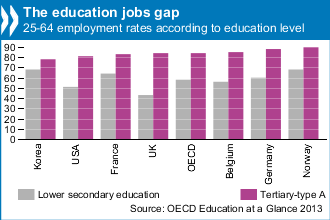
Leaving school with good qualifications is more essential than ever,” said OECD Secretary-General Angel Gurría. “Countries must focus efforts on helping young people, especially the less well-educated who are most at risk of being trapped in a low skills, low wage future. Priorities include reducing school dropout rates and investing in skills-oriented education that integrates the worlds of learning and work.
Though the focus should remain on quality of spending, Governments must ensure that investment in education does not fall as a result of the crisis.”
This year’s report finds new evidence of the value of vocational qualifications as a pathway to employment: countries with a higher than average (32%) share of vocational graduates, such as Austria, Germany, Luxembourg and Switzerland, saw unemployment rise much less or even fall among 25-34 year-olds than their peers with general upper secondary qualifications.
The crisis has also widened the earnings gap: the average difference in earnings from employment between the low educated and the highly educated has risen from 75% across OECD countries in 2008 to 90% in 2011. On average, the relative earnings of tertiary-educated adults are over 1.5 times that of adults with upper secondary education. People with upper secondary education earn 25% more than their peers who left school early.
One outcome of the crisis has been a rise in the number of young people staying on at school, as their job prospects declined. Since 2008, the percentage of 15-29 year-olds who continued in education increased by an average of 1.5 percentage points among OECD countries.
But the crisis has halted the long-term trend of rising investment in education. Public spending on educational institutions between 2009 and 2010 as a percentage of GDP fell by 1% on average across the OECD area.
Public expenditure on educational institutions decreased in one- third of countries during that period, by 2% or less in Austria, Ireland, New Zealand, Norway, Portugal, Spain and the United States. Drops of more than 2% were seen in Estonia, Hungary, Iceland, Italy and Russian Federation. Education budget cuts took place in 2011 and 2012 in 15 OECD countries. |
At the tertiary level, between 2005 and 2010, spending per tertiary student fell in 8 countries, as expenditure did not keep up with expanding enrolments. Austria, Iceland, Israel, the United Kingdom and the United States, which saw significant increases in student enrolment between 2005 and 2010, did not increase spending at the same pace as enrolment grew. Public spending per student also fell in New Zealand, the Russian Federation and Switzerland.
Education at a Glance provides comparable national statistics measuring the state of education worldwide. The report analyses the education systems of the 34 OECD member countries, as well as Argentina, Brazil, China, India, Indonesia, Russia, Saudi Arabia and South Africa.
Key findings
Educational attainment
- The rate of tertiary education attainment among adults in OECD countries has increased by almost 10 percentage points since 2000, but still less than 35% of both men and women attain tertiary education.
- Most graduates at all levels of tertiary education are women, except at the doctoral level. Based on current patterns of graduation, it is estimated that an average of 48% of today’s young women and 32% of today’s young men in OECD countries will complete tertiary education over their lifetimes.
- More young women are graduating from vocational programmes than ever before at upper secondary level. Their graduation rates are now approaching those of men: 45% compared to 49%. In Australia, Belgium, Brazil, Chile, China, Finland, Iceland, Ireland, the Netherlands, Portugal and Spain, vocational graduate rates are higher for women than for men.
Education spending
- On average, OECD countries spend USD 9,313 per student from primary through tertiary education: USD 7,974 per primary student, USD 9,014 per secondary student, and USD 13,528 per tertiary student.
- The share of public funding for tertiary institutions has fallen steadily: from 77% in 1995, to 76% in 2000, to 71% in 2005 and then to 68% in 2010.
- Teachers with maximum qualifications at the top of their salary scales are paid, on average, USD 47,243 at pre-primary level, USD 49,609 at primary, USD 52, 697 at lower secondary, and USD 53,449 at upper secondary. Only in France and Japan have salaries declined between 2000 and 2011.
Education and health
- More-educated adults are less likely to smoke and be obese.
- Adults with a tertiary education are half as likely to be obese compared to those with a below upper secondary education. Tertiary-educated adults in 23 OECD countries are 16 percentage points less likely to smoke, on average, than those with a below upper secondary education.
School environment
- Students in OECD countries are expected to receive an average of 7,751 hours of instruction during primary and lower secondary education. At primary level, reading, writing and literature, maths and science make up 51% of compulsory instruction time and 41% at lower secondary level.
- Public school teachers teach an average of 994 hours per year at pre-primary level, 790 at primary, 709 at lower secondary, and 664 at upper secondary.
- Teaching hours vary widely between countries: public primary teachers teach less than 600 hours in Greece and Russia to over 1,000 in Chile and the US; in public upper secondary, teachers teach 369 hours in Denmark but 1,448 in Argentina.
Further information on Education at a Glance, including country notes, multilingual summaries and key data, is available at www.oecd.org/edu/eag.htm
Related article
Let’s Begin with the Letter People® has no discernible effects on oral language or phonological processing
The What Works Clearinghouse (WWC) has an updated report on the preschool literacy programs Let’s Begin with the Letter People®.
Let’s Begin with the Letter People® is an early childhood literacy curriculum that uses 26 thematic units (each of which covers a letter of the alphabet) to develop children’s language and early literacy skills. A major focus of the program is phonological awareness, including rhyming, word play, alliteration, and segmentation. The WWC found that Let’s Begin with the Letter People® has no discernible effects on oral language or phonological processing and mixed effects on print knowledge for preschool children.
Doors to Discovery™ has potentially positive effects on oral language and print knowledge
The What Works Clearinghouse (WWC) has released an updated report on a preschool literacy programs, Doors to Discovery.
Doors to Discovery™ is a preschool literacy curriculum that uses eight thematic units of activities to help children build fundamental early literacy skills in oral language, phonological awareness, concepts of print, alphabet knowledge, writing, and comprehension. The eight thematic units cover topics such as nature, friendship, communities, society, and health. Each unit is available as a kit that includes various teacher resources.
The What Works Clearinghouse (WWC) identified three studies of Doors to Discovery™ that both fall within the scope of the Early Childhood Education topic area and meet WWC evidence standards. One study meets standards without reservations and two studies meet WWC evidence standards with reservations. Together, these studies included 585 preschool children aged three to five years old in three locations.
Doors to Discovery™ was found to have potentially positive effects on oral language and print knowledge and no discernible effects on phonological processing and math for preschool children.
How School and District Leaders Support Classroom Teachers’ Work With English Language Learners
This study examines the ways in which school and district leaders create systems of support for classroom teachers who work with linguistically diverse students. The authors attempt to uncover the intentional supports leaders put in place for classroom teachers and how this may be part of a broader teaching and learning effort.
Through a qualitative case study of four districts serving different populations of English Learner (EL) students, the authors examine school and district leadership actions aimed at helping teachers provide instruction that is responsive to EL learning needs. In each of the four districts, three schools were chosen for in-depth analysis. Through interviews, classroom observations, and document analyses, we highlight the efforts of school and district leaders to bring about instructional change.
he findings from this study are organized around five central themes. These themes include (1) resolving fragmentation by focusing on high-quality instruction, (2) creating a productive blend of district- and school-level leadership initiatives, (3) communicating a compelling rationale, (4) differentiating support systems at elementary and secondary levels, and (5) using data for instructional improvement. This study extends research on the role of school and district leaders in supporting classroom teachers’ work with second language learners.
Monday, June 24, 2013
Quality Matters More Than Quantity for Word Learning
Several studies have shown that how much parents say to their children when they are very young is a good predictor of children’s vocabulary at the point when they begin school. In turn, a child’s vocabulary size at school entry strongly predicts level of success throughout schooling even into high school and college.
A new study by psychologists at the University of Pennsylvania now shows that early vocabulary improvement is likely to have more to do with the “quality” of the interactions in which the words are used rather than the sheer quantity of speech directed at young children. Moreover, the study shows that, unlike quantity, the quality of these interactions is not related to the parents’ socioeconomic status.
The study was conducted by professors John Trueswell and Lila Gleitman, both of the Department of Psychology in Penn’s School of Arts and Sciences, as well as by Erica Cartmill and Susan Goldin-Meadow of the University of Chicago. Also contributing to the study were Benjamin Armstrong III of Penn and Tamara Medina of Drexel University.
It was published in the Proceedings of the National Academy of Sciences.
Knowing how critical early-language acquisition is to a person’s future success, Trueswell and Gleitman have long investigated the mechanisms involved in how children learn their first words. One of their previous studies suggests that children learn these words in what might be described as a “eureka” moment — that is, only after “highly informative” examples of speech that clearly connect the word to the thing it refers to.
The researchers suspected these highly informative examples would matter much more than the sheer amount of talk in the home when it came to which children learned more words. To determine if this was the case, they set out to track the long-term effects of these examples, seeing if children who had been exposed to them more often did better on a vocabulary test three years later. However, to begin this study, the researchers first had to determine what constituted highly informative speech.
To quantify this phenomenon, the researchers visited more than 50 families from various backgrounds in their homes and videotaped parents interacting with their children. They made these visits when the children were 14 months old and then again four months later.
The researchers edited these taped interactions down to 40-second segments, each centered on one instance of a parent saying a common, concrete noun, such as “book,” “ball” or “dog.” The researchers showed these segments to adult volunteers but muted the video until the parent reached the target word, which was replaced by a beep. The volunteers were asked to guess the word the parent was saying in each instance.
“We purposely chose videos of parents interacting with their children in the home because of the complexity there,” Trueswell said. “Our intuitions are a little misleading; we think it’s going to be a simple environment, but there’s all sorts of things happening at once and changing on a second-by-second basis. Identifying a particular word’s referent, especially when you don’t know any words to begin with, is not a simple task.”
By taking out the verbal context, the volunteers experience the taped situations in the way the children experience it, as they don’t yet understand any of the words and must rely on environmental clues to first learn them. The researchers also discarded any examples where the child might already know the word in question. In those cases, volunteers might be able to pick up clues from the child rather than the parent, and the parent might be less conscientious about connecting the meaning of a word to its referent.
“We see that the more an environment maximizes the ‘here and nowness’ of speech, such as when a parent is gesturing or looking at the object in question, the more likely it is that an interaction will be highly informative,” Gleitman said. “And it turns out this is surprisingly hard to do; only 7 percent of the examples were able to be guessed correctly by more than half of the adults we showed them to.”
If more than half the adults could guess an example’s target word correctly, that suggested the interaction was highly informative. The researchers used this approach to determine approximately how frequently each child in the study heard these highly informative examples. They found a surprising amount of variability: the parents who provided the highest rate of highly informative examples did so 38 percent of the time, while those who provided the lowest rate did so only 4 percent of the time.
“This means that some parents are providing 10 times as much highly informative learning instances as others,” Gleitman said.
The effect of this discrepancy was clear when the researchers tracked how well each of the children did on a standard vocabulary test three years later. The more frequently a child heard highly informative examples of speech, the better he or she did on these tests.
Increasing the quantity of speech was also beneficial but only because it increased the number of chances parents had to provide highly informative examples.
“Fortunately, low-informative instances seem to be ignored,” Trueswell said. “By talking to children more, it’s not as if you’re giving them bad data, you’re only increasing the opportunity to find those nuggets.”
Critically, the rate at which a parent gave highly informative examples to their children wasn’t correlated to the amount they spoke to them in total. This is potentially hopeful news, given the studies that link low socioeconomic status, or SES, to low speech quantity and thus to poor scholastic performance.
“There are a variety of reasons why low-SES parents are speaking less to their children,” Trueswell said, “but, when they do speak to them, their natural predispositions about talking about the ‘here and now’ don’t seem to be correlated to their SES.”
And while the exact mechanisms that lead to a particular bit of speech being highly informative will need to be determined in future research, the Penn team’s study shows how these quality examples can have an overriding and lasting effect on an important stage of a child’s development.
“You can see this effect even with all the variations in their lives and personalities,” Gleitman said. “Through all of that noise, the signal of a linear relationship between these highly informative examples and their children’s performance on that vocabulary test three years later shines through.”
Friday, June 21, 2013
Effectiveness of Cognitive Tutor Algebra I at Scale
This article examines the effectiveness of a technology-based algebra curriculum in a wide variety of middle schools and high schools in seven states. Participating schools were matched into similar pairs and randomly assigned to either continue with the current algebra curriculum for two years or to adopt Cognitive Tutor Algebra I (CTAI), which uses a personalized, mastery-learning, blended-learning approach. Schools assigned to implement CTAI did so under conditions similar to schools that independently adopt it.
Analysis of posttest outcomes on an algebra proficiency exam finds no effects in the first year of implementation, but strong evidence in support of a positive effect in the second year. The estimated effect is statistically significant for high schools but not for middle schools; in both cases, the magnitude is sufficient to improve the average student's performance by approximately eight percentile points.
Related article
Mindfulness Can Increase Wellbeing and Reduce Stress in School Children
Mindfulness -- a mental training that develops sustained attention that can change the ways people think, act and feel -- could reduce symptoms of stress and depression and promote wellbeing among school children, according to a new study published online by the British Journal of Psychiatry.
With the summer exam season in full swing, school children are currently experiencing higher levels of stress than at any other time of year. The research showed that interventions to reduce stress in children have the biggest impact at this time of year. There is growing evidence that mindfulness-based approaches for adults are effective at enhancing mental health and wellbeing. However, very few controlled trials have evaluated their effectiveness among young people.
A team of researchers led by Professor Willem Kuyken from the University of Exeter, in association with the University of Oxford, the University of Cambridge and the Mindfulness in Schools Project, recruited 522 pupils, aged between 12 and 16 years, from 12 secondary schools to take part in the study. 256 pupils at six of the schools were taught the Mindfulness in Schools Project's curriculum, a nine week introduction to mindfulness designed for the classroom.
Richard Burnett who co-created the curriculum said: "Our mindfulness curriculum aims to engage even the most cynical of adolescent audience with the basics of mindfulness. We use striking visuals, film clips and activities to bring it to life without losing the expertise and integrity of classic mindfulness teaching."
The other 266 pupils at the other six schools did not receive the mindfulness lessons, and acted as a control group.
All the pupils were followed up after a three month period. The follow-up was timed to coincide with the summer exam period -- which is a potential time of high stress for young people. The researchers found that those children who participated in the mindfulness programme reported fewer depressive symptoms, lower stress and greater wellbeing than the young people in the control group. Encouragingly, around 80% of the young people said they continued using practices taught in MiSP's mindfulness curriculum after completing the nine week programme. Teachers and schools also rated the curriculum as worthwhile and very enjoyable to learn and teach.
Lead researcher Professor Kuyken said: "Our findings provide promising evidence of the effectiveness of MiSP's curriculum. We found that those young people who took part in the programme had fewer low-grade depressive symptoms, both immediately after completing the programme and at three-month follow-up. This is potentially a very important finding, given that low-grade depressive symptoms can impair a child's performance at school, and are also a risk factor for developing adolescent and adult depression."
Professor Katherine Weare, who has been instrumental in promoting the teaching of resilience in schools, said: "These findings are likely to be of great interest to our overstretched schools who are trying to find simple, cost effective and engaging ways to promote the resilience of their students -- and of their staff too -- at times when adolescence is becoming increasingly challenging, staff under considerable stress, and schools under a good deal of pressure to deliver on all fronts. This study demonstrates that mindfulness shows great promise in promoting wellbeing and reducing problems -- which is in line with our knowledge of how helpful well designed and implemented social and emotional learning can be. The next step is to carry out a randomised controlled trial into the MiSP curriculum, involving more schools, pupils and longer follow-ups."
Professor Felicia Huppert of the University of Cambridge said: "The findings also support the argument that mindfulness training can enhance the psychological well-being of all pupils, not just those who have symptoms associated with common mental health problems. Psychological well-being has been linked to better learning, social relationships and academic performance, so the enhancement of well-being is likely to improve a range of outcomes in the school context."
Thursday, June 20, 2013
Student Engagement—Essential for Success in School—Is More Complex, Changeable Than Previously Thought
“Enhancing student engagement has been identified as the key to addressing problems of low achievement, high levels of student misbehavior, alienation, and high dropout rates.” – Pitt professor Ming-Te Wang
A student who shows up on time for school and listens respectfully in class might appear fully engaged to outside observers, including teachers. But other measures of student engagement, including the student’s emotional and cognitive involvement with the course material, may tell a different story—one that could help teachers recognize students who are becoming less invested in their studies, according to a new study coauthored by a University of Pittsburgh researcher.
More importantly for educators, the study, published online in the professional journal Learning and Instruction, suggests that student engagement—essential for success in school—is malleable, and can be improved by promoting a positive school environment. The result paves the way for future work to offer teachers diagnostic tools for recognizing disengagement, as well as strategies for creating a school environment more conducive to student engagement.
“Enhancing student engagement has been identified as the key to addressing problems of low achievement, high levels of student misbehavior, alienation, and high dropout rates,” said Ming-Te Wang, assistant professor of psychology in education in the School of Education and of psychology in the Kenneth P. Dietrich School of Arts and Sciences at Pitt, who coauthored the study with Jacquelynne S. Eccles, the Wilbert McKeachie and Paul Pintrich Distinguished University Professor of Psychology and Education at the University of Michigan.
“When we talk about student engagement, we tend to talk only about student behavior,” Wang added. “But my coauthor and I feel like that doesn’t tell us the whole story. Emotion and cognition are also very important.”
Wang and Eccles’ study is among the first attempts by researchers to use data to explore a multidimensional approach to the question of student engagement. In the past, only behavioral measures of student engagement—such as class attendance, turning in homework on time, and classroom participation—had been evaluated when gauging student engagement. By conducting a study linking students’ perceptions of the school environment with behavior, the authors have provided one of the first pieces of empirical research supporting the viability of the multidimensional perspective, which had previously been largely theoretical.
The researchers designed a 100-question survey that includes the evaluation of emotional engagement and cognitive engagement. Sample survey questions that tested emotional engagement in classes across all subject areas asked students to agree or disagree with statements such as “I find schoolwork interesting” and “I feel excited by the work in school.” Sample questions concerning cognitive engagement asked students to provide ratings to questions like “How often do you make academic plans for solving problems?” and “How often do you try to relate what you are studying to other things you know about?”
Using the survey, Wang and Eccles conducted a two-year longitudinal study, tracking approximately 1,200 Maryland students from seventh through eighth grade. The authors also measured students’ perceptions of their environment by having them answer questions in five areas: school structure support, which gauged the clarity of teacher expectations; provision of choice, which assessed students’ opportunities to make learning-related decisions; teaching for relevance, which evaluated the frequency of activities deemed relevant to students’ personal interests and goals; students’ perceptions of the emotional support offered by teachers; and students’ perceptions of how positive their relationships were with fellow students.
The authors found that students who felt that the subject matter being taught and the activities provided by their teachers were meaningful and related to their goals were more emotionally and cognitively engaged than were their peers. Adding measures of emotional and cognitive engagement could broaden researchers’ perspectives on student engagement in future work in this area.
Also among the paper’s main findings is that the school environment can and, indeed, should be changed if it is impeding student engagement. A positive and supportive school environment is marked, Wang said, by “positive relationships with teachers and peers. Schools must provide opportunities for students to make their own choices. But they also must create a more structured environment so students know what to do, what to expect, from school.” Wang also noted, however, that there is no “one size fits all” strategy to the problem of student engagement.
“Usually people say, ‘Yes, autonomy is beneficial. We want to provide students with choices in school,’” Wang said. “This is the case for high achievers, but not low achievers. Low achievers want more structure, more guidelines.”
As a result, Wang said, teachers must take into account individual variation among students in order to fulfill the needs of each student.
Wang’s current work, undertaken in partnership with six Allegheny County school districts, focuses on developing a diagnostic tool that teachers can use to identify students who are disengaged from school, with a specific emphasis on math and science classes.
The paper is titled “School context, achievement motivation, and academic engagement: A longitudinal study of school engagement using a multidimensional perspective.” It is scheduled to appear in the December 2013 print issue of Learning and Instruction. It appeared online in that publication May 21, 2013.
Bullying and suicide among youth is a public health problem
Expert research from CDC panel provides details and clarity, reports the Journal of Adolescent Health
Recent studies linking bullying and depression, coupled with extensive media coverage of bullying-related suicide among young people, led the Centers for Disease Control and Prevention (CDC) to assemble an expert panel to focus on these issues. This panel synthesized the latest research about the complex relationship between youth involvement in bullying and suicide-related behaviors. Three themes emerged: 1) Bullying among youth is a significant public health problem, with widespread and often harmful results; 2) There is a strong association between bullying and suicide-related behaviors; and 3) Public health strategies can be applied to prevent bullying and suicide.
A special supplement of the Journal of Adolescent Health presents the panel's findings, introduced by an insightful editorial by Marci Feldman Hertz, MS, Centers for Disease Control and Prevention, Atlanta, Georgia, and Ingrid Donato and James Wright, MS, LCPC, Center for Mental Health Services, Substance Abuse and Mental Health Services Administration, Rockville, Maryland.
Between 20 and 56 percent of young people are involved in bullying annually, as either a victim or perpetrator, or both. While bullying situations vary by type, age, and duration, middle school-aged children are more likely to be involved in bullying than those in high school. Verbal bullying occurs more frequently than physical or cyber-bullying and is more likely to happen over a longer time period. Further, lesbian and gay youth are more likely to be victimized than heterosexuals.
Poor mental and physical health among the victims and perpetrators of bullying, and those who experience both victimization and perpetration, investigators say, contribute to the problem. Further, involvement in bullying can have long-lasting, harmful effects, such as depression, anxiety, abdominal pain, and tension, months or even years later, as reported by two studies in this special supplement.
Researchers demonstrate a strong link between involvement in bullying and suicide. Dorothy Espelage and Melissa K. Holt, authors of "Suicidal Ideation and School Bullying Experiences After Controlling for Depression and Delinquency," show that the idea of suicide and attempts at suicide among middle school students were three-to-five times greater than among uninvolved students.
By applying public health strategies, researchers assert that bullying can be prevented, improving health and mental outcomes for many youth. Articles such as "Suicidal Thinking and Behavior Among Youth Involved in Verbal and Social Bullying: Risk and Protective Factors," by Iris Wagman Borowsky, Lindsay A. Taliaferro, and Barbara J. McMorris, reinforce the call for an integrated approach of multiple strategies to prevent suicide by focusing on shared risk and protective factors, including individual coping skills, family and school social support, and supportive school environments.
Notes the supplement's guest editor, Marci Feldman Hertz, "Given the prevalence and impact of bullying, it is important to move forward while public health strategies are still being developed. We can begin by implementing and evaluating strategies that have demonstrated effectiveness at increasing protective factors and decreasing risk factors associated with both bullying and suicide." Education and health stakeholders, she adds, should consider broadening their focus beyond just providing services to those already involved in bullying or suicide-related behaviors. They should also implement strategies to prevent bullying and suicide behavior from occurring in the first place.
Wednesday, June 19, 2013
The vital role of the humanities and social sciences
A new report by the American Academy of Arts & Sciences Commission on the Humanities and Social Science, titled The Heart of the Matter, looks at the vital role of the humanities and social sciences in preparing and sustaining Americans for the responsibility of productive citizenship in the United States and the world.
The Heart of the Matter focuses on five areas of concern—K-12 Education; Two- and Four-Year Colleges; Research; Cultural Institutions and Lifelong Learning; and International Security and Competitiveness—and makes recommendations to achieve three goals:
- Educate Americans in the knowledge, skills, and understanding needed to thrive in
a 21st century democracy:- Invest in the preparation of citizens
with a thorough grounding in history, civics, and social studies. - Increase access to online resources,
including teaching materials.
- Invest in the preparation of citizens
- Foster an innovative, competitive, and strong society.
- To ensure the vibrancy of humanities
and social science programs at all levels, philanthropists, states, and the federal
government should significantly increase funding designated for these purposes. - Create a Humanities Master Teacher
Corps to complement the STEM Master Teacher Corps recently proposed by the White
House.
- To ensure the vibrancy of humanities
- Equip the nation for leadership in an interconnected world.
- Develop a “Culture Corps” that would
match interested adults (retirees, veterans, artists, library and museum personnel)
with schools, community centers, and other organizations to transmit humanistic
and social scientific expertise from one generation to the next. - Expand education in international
affairs and transnational studies.
- Develop a “Culture Corps” that would
Tuesday, June 18, 2013
Foster Youth Face Significant Academic Hurdles
A new study, Foster Youth Transitions, released by the Institute for Evidence-Based Change (IEBC), in conjunction with the University of California, Berkeley’s Center for Social Science Research (CSSR), examines the educational outcomes of foster youth in comparison to peers from similar disadvantaged backgrounds. Foster youth often experience instability and are deprived of support vital for the completion of educational milestones, such as high school graduation and college enrollment.
Results from the study, a longitudinal survey which tracks the educational outcomes of more than 11,000 California high school students over five school years, show that foster youth are less likely to complete high school, and enroll and persist in postsecondary education compared to closely matched non-foster youth.
The study offers recommendations to help foster youth succeed academically. Ongoing, personalized education assessment of students, school quality, and educational supports, such as dual enrollment and financial aid, should be emphasized to improve the educational outcomes for foster youth.
The schools preparing teachers have become an industry of mediocrity
The National Council on Teacher Quality (NCTQ)'s Teacher Prep Review reports that the colleges and universities producing America’s traditionally prepared teachers have become an industry of mediocrity, churning out first-year teachers with classroom management skills and content knowledge inadequate to thrive in classrooms with ever-increasing ethnic and socioeconomic student diversity.
They assigned overall ratings based on a set of key standards for 608 institutions. Those ratings can be found at www.nctq.org/teacherPrep, where there is additional data on another 522 institutions.
The webpage provides access to a variety of materials, including more detailed findings by state, by standard and by individual program; resources for program improvement; rationales and scoring methodologies for each standard; and more information about outside advisory groups and expert evaluators. Altogether, the Review provides data on the 1,130 institutions that prepare 99 percent of the nation’s traditionally trained new teachers. No small feat.
The evaluations provide evidence, based on a four-star rating system, that a vast majority of teacher preparation programs do not give aspiring teachers adequate return on their investment of time and tuition dollars. These are among the most alarming findings:
- Less than 10 percent of rated programs earn three stars or more. Only four programs, all secondary, earn four stars: Lipscomb and Vanderbilt, both in Tennessee; Ohio State University; and Furman University in South Carolina. Only one institution, Ohio State, earns more than three stars for both an elementary (31/2 stars) and a secondary (4 stars) program.
-It is far too easy to get into a teacher preparation program. Just over a quarter of programs restrict admissions to students in the top half of their class, compared with the highest-performing countries, which limit entry to the top third.
- Fewer than one in nine elementary programs and just over one-third of high school programs are preparing candidates in content at the level necessary to teach the new Common Core State Standards now being implemented in classrooms in 45 states and the District of Columbia.
-The “reading wars” are far from over. Three out of four elementary teacher preparation programs still are not teaching the methods of reading instruction that could substantially lower the number of children who never become proficient readers, from 30 percent to under 10 percent. Instead, the teacher candidate is all too often told to develop his or her “own unique approach” to teaching reading.
- Just 7 percent of programs ensure that their student teachers will have uniformly strong experiences, such as only allowing them to be placed in classrooms taught by teachers who are themselves effective, not just willing volunteers.
- More than three-quarters of the programs, 78 percent, earn two or fewer stars, ratings that connote, at best, mediocrity.
- The weakest programs, those with a rating of no stars (14 percent), earn a “Consumer Alert” designation ! . While these low-rated institutions certainly can produce good teachers, it is less by design than happenstance: a chance placement with a great mentor or assignment to a strong section of an otherwise weak course.
Twenty-five years ago, if you asked a teacher how much experience he or she had, the most common response would have been 15 years; if you ask the same question of teachers today, the answer is one year. The real challenge is that first-year teachers now teach around 1.5 million students every year, many of whom, because of district placement practices, are already behind in their learning.
Does arts education really have a positive impact on academic skills?
Arts education is commonly said to be a means of developing skills considered as critical for innovation: critical and creative thinking, motivation, self-confidence, and ability to communicate and cooperate effectively, but also skills in non-arts academic subjects such as mathematics, science, reading and writing. Does arts education really have a positive impact on the three subsets of skills that we define as “skills for innovation”: technical skills, skills in thinking and creativity, and character (behavioral and social skills)?
This report, called "Art for Art's Sake: The Impact of Arts Education," is from the Centre for Educational Research and Innovation based in Paris at the Organisation for Economic Co-operation and Development (OECD) answers this question by updating and extending to behavioural and social skills the meta-analyses published in 2000 by the “Reviewing Education and the Arts Project” (REAP) directed by Hetland and Winner. Meta-analyses combine existing studies on a specific topic to assess whether a finding is consistent and has enough statistical power to be generalised. In addition to studies already reviewed in the REAP project, this new enquiry involves the systematic investigation of research databases in education and psychology in the following languages: Dutch, English, Finnish, French, German, Italian, Japanese, Korean, Portuguese, Spanish and Swedish.
The kinds of arts education examined include arts classes in school (classes in music, visual arts, theatre, and dance), arts integrated classes (where the arts are taught as a support for an academic subject), and arts study undertaken outside of school (e.g. private, individualized instrumental music lessons; out of school classes in theatre, visual arts, and dance). The report does not deal with education about the arts or cultural education, which may be included in all kinds of subjects.
The main results to emerge are summarized below.
Arts education and academic skills in non-arts subjects
Multi-arts education. An extensive body of correlational data in the United States reveals that students who participate in a large number of arts courses (likely a mixture of kinds of arts courses) have higher educational achievement (as measured by grades in school and scores on verbal and mathematical standardised tests) than those who take fewer or no arts courses. One study showed that this relationship exists for students at both the high and low ends of the socio-economic spectrum.
These correlational findings should not be taken as showing that the arts courses cause the higher educational attainment. Plausible non-causal explanations cannot be ruled out: students who excel academically and who study the arts may come from families who value both academics and the arts, or attend schools that stress both; and good scores or educational ability no doubt have a positive influence on whether students receive arts education, for example because those proficient at school have more time to spend on the activities concerned, or are encouraged more to do so by their teachers or parents.
It is notable that a similar study in the United Kingdom found the reverse: students in the arts track performed less well on their national exams than did those in the academic track – pointing to the importance of considering the kinds of students who self-select into the arts. The handful of multi-arts experimental studies examining the effect of arts classes on educational attainment do not (yet) show a significant causal impact.
Music. Music education strengthens IQ (intelligence quotient), academic performance, word decoding and phonological skills and there is preliminary evidence that music education might facilitate foreign language learning. While there are a number of studies showing a positive impact of music education on visual-spatial reasoning, the sole longitudinal study on this question detected no persistent influence after three years of music, which suggests the need for caution. There is also no evidence that music education has any causal impact on mathematics scores, even though mathematicians may be attracted to music.
Theatre. Strong evidence shows that theatre education in the form of enacting stories in the classroom (classroom drama) strengthens verbal skills, but there is no evidence for a link between theatre training and overall academic skills.
Visual arts. While there is no evidence that training in visual arts improves overall academic skills or verbal skills (literacy), two new correlational studies reveal that students who study the visual arts are stronger in geometrical reasoning than students who do not study the visual arts. However, causality has yet to be established. And one experimental study found that learning to look closely at works of visual art improves skills in observing scientific images – a typical instance of close skills transfer.
Dance. Some studies show that instruction in dance improves visual-spatial skills, but such studies are still too few in number to be conclusive. We found no evidence that dance education improves overall academic skills or reading.
Arts education and skills in thinking and creativity
Everyone associates art with creativity. There are a few studies linking enhanced creativity with theatre and dance education, but the limited number of studies and statistical power of the positive evidence do not allow us to generalise this finding. Research on multi-arts education has not clearly demonstrated a causal impact on student creativity and problem solving.
One possible reason for the weak evidence on this question is the limited way in which creativity has been measured – using ”domain-general” tests such as the Torrance Tests of Creativity (in which students must for example come up with original uses for common objects, or title pictures in unusual ways). Another possible reason is that anything can be taught so as to stimulate creativity and imagination, and anything can also be taught in a deadening way. Thus, a science class – indeed, a class in any subject – can teach creativity and imagination if well-taught; and an art class can leave creativity and imagination untouched if poorly taught. Even in art, these skills may well only be developed very deliberately. It is also possible that students who gain expertise in an art form develop creative abilities in that art form but that this new creativity does not spill over into other domains.
The authors did not find any empirical study assessing the impact of arts education on critical thinking. However, a study showed that visual arts teachers at their best aim to promote reflection and meta-cognition.
Arts education and social and behavioural skills
Arts education is often viewed by public policy-makers and educators as a means of getting students to enjoy school and motivate them for learning in other academic subjects. Empirical studies show that students enrolled in arts education courses display a more ambitious attitude to academic work as well as higher levels of commitment and motivation. However, these studies are correlational and thus do not allow the conclusion that arts education is what motivates students. Possible non-causal explanations exist: for example, students taking the arts may attend schools that are better all around and thus more motivating; or students who self-select into the arts may be more motivated to begin with. Experimental (causal) studies are called for.
Finally, there is no more than tentative evidence regarding the impact of arts education in its various forms on other behavioural and social skills, such as self-confidence, self-concept, skills in communication and cooperation, empathy, perspective taking and the ability to regulate one’s emotions by expressing rather than suppressing them. Initial evidence concerned with education in dramatic art appears the most promising, with a few studies revealing that drama classes enhance empathy, perspective taking, and emotional regulation – plausible findings given the nature of such education.
Conclusions: art for art’s sake?
Even though the researchers find some evidence of impact of arts education on different kinds of skills, they maintain that the main justification for arts education is clearly the acquisition of artistic habits of mind – the current priority objective of arts education in the curricula of OECD countries. By artistic habits of mind, they mean not only the mastery of craft and technique, but also skills such as close observation, envisioning, exploration, persistence, expression, collaboration, and reflection – the skills in thinking and creativity and the social and behavioural skills that are developed in the arts.
There is some suggestive evidence that arts education does matter for innovation because people trained in the arts play a significant role in the innovation process in OECD countries: arts graduates are for example commonly involved in product innovation. Recognising the value of arts education for innovation, an increasing number of universities are developing new types of inter-disciplinary curricula or institutions that try to take advantage of the skills developed in arts education.
If learning in the arts has “collateral benefits” in other areas, so much the better. However, the authors do not believe that the existence of arts education should be justified in terms of skills in other academic subjects: if one seeks first and foremost to develop skills in geometry, studying geometry – rather than music or dance – is always likely to be more effective. The primary justification of arts education should remain the intrinsic value of the arts and the related skills and important habits of mind that they develop.
Ultimately, the impact of arts education on other non-arts skills and on innovation in the labour market should not be the primary justification for arts education in today’s curricula. The arts have been in existence since the earliest humans, are parts of all cultures, and are a major domain of human experience, just like science, technology, mathematics, and humanities. The arts are important in their own rights for education. Students who gain mastery in an art form may discover their life’s work or their life’s passion. But for all children, the arts allow a different way of understanding than the sciences. Because they are an arena without right and wrong answers, they free students to explore and experiment. They are also a place to introspect and find personal meaning.
Friday, June 14, 2013
Moral vs. Performance Character Development in Urban Adolescents
This study compared the effects of emphasizing moral character development or performance character development at three high-performing, high-poverty urban middle schools.
Performance character consists of the qualities that allow individuals to regulate their thoughts and actions in ways that support achievement in a particular endeavor. Moral character consists of the qualities relevant to striving for ethical behavior in one’s relationships with other individuals and communities.
Using a quasi-experimental research design, the authors found that early adolescents attending a school emphasizing moral character development through ethical philosophy programming demonstrated significantly higher levels of integrity over the course of the 2010 to 2011 academic year than their peers at two matched comparison schools (N = 544). However, the early adolescents attending the comparison schools—which emphasized performance character development through advisory programming—demonstrated significantly higher levels of perseverance and community connectedness over the course of the academic year.
Wednesday, June 12, 2013
Laws help limit junk foods in schools
District policies and state laws help reduce the availability of sugar- and fat-laden foods and beverages in elementary schools, according to a study published online in JAMA Pediatrics.
Researchers at the University of Illinois at Chicago looked at the association between established policies and laws and the availability of candy, baked goods, ice cream, chips, sugar-sweetened beverages, and soda sold outside the school meal program. More than 1,800 elementary schools in 45 states responded to surveys during the 2008-2009 and 2010-2011 school years.
The researchers found that in schools without district or state guidelines limiting sugar content in foods, 43.5 percent sold sweets. When both district and state guidelines restricted the sale of sweets, only 32.3 percent of schools — nearly a quarter fewer — sold these foods.
The study shows that “policies can improve the elementary school food and beverage environment, and state and district policies are often reinforcing one another,” says Jamie Chriqui, lead author of the study and senior research scientist at UIC’s Institute for Health Research and Policy.
Sugar-sweetened beverages were available in only one-fourth as many schools that had a district-wide ban as in those that had no policy (3.6 percent and 13.1 percent of schools, respectively). But the availability of sugar-sweetened beverages was not influenced by state policies.
Public elementary schools are required, through an unfunded federal mandate, to have a wellness policy with nutritional guidelines for “competitive” foods and beverages — those that vie with items in the school meal program.
“Given the problems we have with overconsumption of sugar-sweetened beverages by children and youth, the fact that unfunded district policies are actually helping to change the availability of sugar sweetened beverages in elementary schools is a really positive sign,” said Chriqui.
However, the study also revealed that the policies are not being fully implemented. For example, the researchers found that of the 121 surveyed schools that were in states with laws prohibiting sale of sugar-sweetened beverages in elementary schools, 22 schools — all in southern states — still sold sugar-sweetened beverages despite the state-wide bans.
Is Starting College and Not Finishing Really That Bad?
In this report, The Hamilton Project examines whether starting college is worth it for students who fail to complete a degree. Their "startling" finding is that it is: these students’ lifetime earnings are roughly $100,000 higher (in present value) than that of their peers who ended their education after high school. Measured by the rate of return, getting some college is an investment with a return that exceeds the historical return on practically any conventional investment, including stocks, bonds, and real estate. (Of course, the return to some college is considerably smaller than the return to finishing either an associate’s or bachelor’s degree.)
The College Earnings Premium
More education corresponds to better employment opportunities, even in the current, tepid job market. In April 2013, according to BLS data, the unemployment rate for individuals age twenty-five and older without a high school diploma was 11.4 percent; for high school graduates, 7.2 percent; for individuals with an associate’s degree, 5.0 percent; and for graduates with a bachelor’s degree or higher, unemployment was only 3.6 percent. Based on a more expansive measure of employment—the employment-to-population ratio—these disparities are even larger. Of all individuals without a high school diploma, age twenty-five and older, only 39.9 percent had a job; for high school graduates with no additional education, the employment rate was 54.5 percent; for individuals with an associate’s degree it was 68.6 percent; and for graduates with a bachelor’s or higher it was 73.2 percent.
The unemployment rate for individuals that reported some college but no degree was below the national average at 6.6 percent and the employment-to-population ratio was 60.9 percent.
In addition to increasing the chances of employment, education also has a substantial effect on one’s earnings potential. The graph below shows the average annual earnings of individuals with varying levels of educational attainment. Those with a bachelor’s degree earn a premium of roughly $30,000 each year relative to those with just a high school diploma. Over a lifetime of work, a college graduate with a bachelor’s degree would earn over $500,000 more than an individual with just a high school diploma.
What has not been previously appreciated is that even those who enroll in a two- or four-year program but do not attain a degree also experience substantial increases in earnings. On average, these individuals made about $8,000 per year more than those with just a high school diploma. Over a lifetime, this results in over $100,000 more in earnings.
High school graduation requirements are out of sync with Common Core
A new report from Change the Equation (CTEq) and the National School Boards Association’s (NSBA) Center for Public Education (CPE) examines the connection between state graduation requirements and Common Core State Standards in math. The report, “Out of Sync: Many Common Core states have yet to define a Common Core-worthy diploma,” found that of the 45 states that have voluntarily adopted Common Core, only 11 have aligned their graduation requirements in mathematics with those standards.
CPE and CTEq have compared states’ high school graduation requirements in math to the Common Core standards to see how well they align and determined that graduation requirements most likely to be aligned to the Common Core standards must include math in each year of high school and convey substantial content typically taught in Algebra I, Geometry, and Algebra II classes. While 11 states are aligned, 13 are only partially aligned, leaving 22 states that have adopted the Common Core but lack corresponding graduation requirements that match the expectations of new standards. Even states whose graduation requirements appear to reflect the demands of the Common Core may still have much work to do to ensure that their high school course sequence and content is truly aligned to the standards.
Monday, June 10, 2013
Reading to children: a head-start in life
This article examines the effect of parental reading to children early in life on the child’s reading skills using the Longitudinal Study of Australian Children (LSAC). In addition to reading skills at age four to five, reading skills at later ages (up to age 10 to 11) are also examined. At most ages, more than one reading skill measure is observed, which allows for checking the consistency of results when using different measures.
The raw data used in the study show patterns indicating a clear association between reading to children more frequently and higher early reading scores. Children who are read to more often are more likely to get a higher score. Girls do slightly better than boys independent of the frequency that they are being read to. This pattern is evident across all measures, with girls doing better than boys in all language-related skills.
For another example of this association, girls who are read to more frequently are more likely to score high at age eight to nine on the NAPLAN test (the National Assessment Program – Literacy and Numeracy (NAPLAN) reading test girls.
Information and Student Achievement: Evidence from a Cellular Phone Experiment
This paper describes a field experiment in Oklahoma City Public
Schools in which students were provided with free cellular phones and
daily information about the link between human capital and future
outcomes via text message.
Students' reported beliefs about the relationship between education
and outcomes were influenced by treatment.
Treatment students also report being more focused and working harder
in school.
However, there were no measureable changes in attendance, behavioral
incidents, or test scores.
The patterns in the data appear most consistent with a model in
which students cannot translate effort into measureable output,
though other explanations are possible.
Strategic Involuntary Teacher Transfers and Teacher Performance: Examining Equity and Efficiency
Despite claims that school districts need flexibility in teacher
assignment to allocate teachers more equitably across schools and
improve district performance, the power to involuntarily transfer
teachers across schools remains hotly contested. Little research has
examined involuntary transfer policies or their effects on schools,
teachers, or students.
This article uses administrative data from Miami-Dade
County Public Schools to investigate the implementation
and effects of the district's involuntary transfer policy, including
which schools transferred and received teachers, which teachers were
transferred, what kinds of teachers replaced them in their former
schools, and how their performance--as measured by their work
absences and value-added in math and reading--compared before and
after the transfer.
The authors find that, under the policy, principals in
the lowest-performing schools identified relatively low-performing
teachers for transfer who, based on observable characteristics, would
have been unlikely to leave on their own. Consistent with an equity
improvement, involuntarily transferred teachers were
systematically moved to higher-performing schools. Efficiency
impacts are mixed; although transferred teachers had nearly 2 fewer
absences per year in their new schools, transferred teachers
continued to have low value-added in their new schools.
How much do teachers vary in performance improvement during their first five years of teaching
Educational policymakers struggle to find ways to improve the quality
of the teacher workforce. The early career period represents a
unique opportunity to identify struggling teachers, examine the
likelihood of future improvement, and make strategic pre-tenure
investments in improvement as well as dismissals to increase teaching
quality. To date, only a little is known about the dynamics of
teacher performance in the first five years.
This paper asks how much teachers vary in performance improvement
during their first five years of teaching and to what extent
initial job performance predictslater performance.
The authors find that, on average, initial performance is
quite predictive of future performance, far more so than typically
measured teacher characteristics. Predictions are particularly
powerful at the extremes.
The authors employ these predictions to explore the
likelihood of personnel actions that inappropriately distinguish
performance when such predictions are mistaken as well as the much
less discussed costs of failure to distinguish performance when
meaningful differences exist. The results have important
consequences for improving the quality of the teacher workforce.
Friday, June 7, 2013
New Study Looks at Discrimination African-American Adolescents Face in Schools
Nearly 60 years after the Supreme Court outlawed racial segregation in public schools, African-American adolescents of all socioeconomic backgrounds continue to face instances of racial discrimination in the classroom. A new study sheds light on that and points to the need for students of color to rely on personal and cultural assets to succeed academically.
The study “African American Adolescents’ Academic Persistence: A Strengths-Based Approach,” was published online May 24 in the Journal of Youth and Adolescence.
“This study is unique in that it is a socioeconomically diverse sample of African-American adolescents — from poverty and low-income environments all the way to those with a high socioeconomic status,” said Sheretta T. Butler-Barnes, PhD, assistant professor at the Brown School at Washington University in St. Louis and lead author.
“School-based racial discrimination experiences are still occurring across the board for these adolescents, and it’s having a negative impact on academic persistence,” she said.
Butler-Barnes said that’s not so much surprising as it is distressing. “It’s 2013 and it’s still an issue,” she said.
The study began when Butler-Barnes was a National Science Foundation post-doctoral fellow at the University of Michigan’s Center for the Study of Black Youth in Context. While not letting schools and institutions off the hook, the research also focuses on ways that an individual’s strengths — racial pride, self-efficacy and self-acceptance — can buffer the negative experiences.
“The study keys in to teachers and parents the need to recognize that these things are still happening,” Butler-Barnes said, noting that schools could hold workshops speaking about race and ethnic differences to raise awareness of what people of color tend to experience in school settings.
Thursday, June 6, 2013
Advances in student achievement since the passage of the 1993 Education Reform Act in Massachusetts
Mass Insight Education has released a summative report reviewing student achievement during the twenty years since the passage of the 1993 Education Reform Act in Massachusetts, which set to transform public education across the state. The anniversary report highlights the significant progress the state has made as a result of the landmark legislation and also provides a call to action to address the challenges that remain - specifically in raising student achievement for underserved populations and in increasing college success rates for all Massachusetts students.
- Statewide scores in Grade 10 MCAS in ELA, math, and science increased but students from low-income families continue to lag behind the state average by 11 percentage points, 16 percentage points and 21 percentage points respectively. (graph)
- The statewide high school graduation rate increased 6 percentage points from 2006-2012 yet students from underserved populations continue to fall below the state average - 10 percentage points lower for African Americans and nearly 20 percentage points lower for Hispanics. (graph)
- Statewide Advanced Placement (AP*) math, science, and English qualifying scores
increased by 44 percent from 2008-2012, but the number of African American and Hispanic students' qualifying scores are nearly 5 times lower than the state average. (graph)
Mass Insight also collected data on post-secondary student outcomes including persistence rates while in college and college graduation rates within six years. In 2010, Massachusetts partnered with Complete College America to focus on the college success rate, which in 2008 was only 57.8 percent. In the report, Mass Insight recommends that the new metric in education reform should be centered around increased college graduation rates, aligning with the state's commitment to College Success.
Mass Insight's 20 Year Anniversary Report: Education Reform In Massachusetts 1993-2013 is available for download at http://www.massinsight.org/news/318/
Trends to Reform the American School Calendar
Learning Time in America: Trends to Reform the American School Calendar, from the National Center on Time & Learning (NCTL) and the Education Commission of the States is an update to a July 2011 report of the same name. It provides a comprehensive overview of legislative and policy developments at the federal, state, and district levels to close achievement gaps and improve public school through expanding learning time over the two years since the release of the first report.
The report also includes results from a national survey, commissioned by NCTL and administered in February by the nonpartisan firm KRC Research, showing broad support for more learning time. Three-quarters of respondents – including 80 percent of parents with children enrolled in public schools – agreed that more time in school will better prepare students for success in college and the workforce.
The report details dozens of policy and legislative developments that have already led to expanded learning time or that pave the way for it in the years to come. These developments include:
- Five states (Colorado, Connecticut, Massachusetts, New York, and Tennessee) in December 2012 announced their participation in the TIME Collaborative, an effort led by NCTL and the Ford Foundation to expand learning time for thousands of students in select schools in those states.
- In New York, in addition to the state’s participation in the TIME Collaborative, the state legislature this year provided $20 million to fund a proposal by Governor Andrew Cuomo to
create a competitive grant program to fund a 25 percent expansion of learning time in schools with redesign plans approved by the state.
- The Florida legislature in 2012 designated a specific funding stream to support the addition of one hour of instruction in literacy for all students in the 100 lowest-performing elementary schools in the state.
- Since 2008, seven states have passed legislation that create “innovation” or “turnaround” districts or schools. Though the specifics vary by state, across all the efforts, the aim is to grant districts or schools autonomies over budgets, staffing, and school schedules.
- Two states – Iowa and North Carolina – formed commissions specifically to study the need to modernize the school calendar.
- School districts have also played a significant role in expanding learning time. For example, Chicago significantly expanded both the school day and the school year for all 340,000 students in its traditional district schools. Elizabeth, New Jersey has created eight-hour days for all 30 of its district schools.
Subscribe to:
Comments (Atom)